


Page 9 - sst_class_06
P. 9
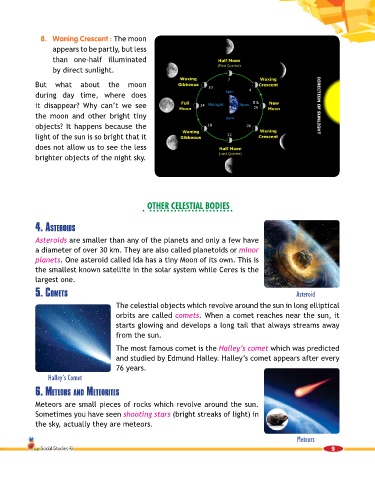
8.  Waning Crescent : The moon

                   appears to be partly, but less
                   than  one-half illuminated
                   by direct sunlight.

             But  what  about  the  moon

             during  day time,  where  does
             it  disappear? Why  can’t  we  see
             the  moon and other  bright  tiny
             objects? It happens because the
             light of the sun is so bright that it

 Waning Crescent  does not allow us to see the less
             brighter objects of the night sky.


                                                    other CeleStial BoDieS


             4. aSTeroidS

             Asteroids are smaller than any of the planets and only a few have
             a diameter of over 30 km. They are also called planetoids or minor
             planets. One asteroid called Ida has a tiny Moon of its own. This is
             the smallest known satellite in the solar system while Ceres is the
             largest one.

             5. CoMeTS                                                                                 Asteroid

                                         The celestial objects which revolve around the sun in long elliptical
                                         orbits are called comets. When a comet reaches near the sun, it
                                         starts glowing and develops a long tail that always streams away
                                         from the sun.

                                         The most famous comet is the Halley’s comet which was predicted
                                         and studied by Edmund Halley. Halley’s comet appears after every
                                         76 years.
                  Halley’s Comet


             6. MeTeorS and MeTeoriTeS
             Meteors are small pieces of rocks which revolve around the sun.
             Sometimes you have seen shooting stars (bright streaks of light) in
             the sky, actually they are meteors.


                                                                                                        Meteors
               Social Studies-6                                                                                     9

