


Page 8 - sst_class_06
P. 8
Dwarf PlanetS


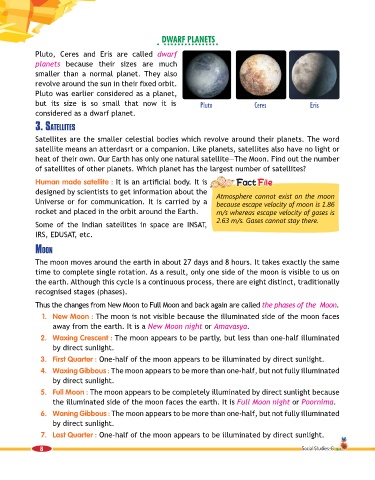
             Pluto,  Ceres  and  Eris are  called  dwarf
             planets because  their  sizes are  much
             smaller  than  a  normal  planet. They  also
             revolve around the sun in their fixed orbit.
             Pluto was earlier considered as a planet,
             but  its size  is so small that  now  it  is             Pluto              Ceres              Eris
             considered as a dwarf planet.

             3. SaTelliTeS

             Satellites are the smaller celestial bodies which revolve around their planets. The word
             satellite means an atterdasrt or a companion. Like planets, satellites also have no light or
             heat of their own. Our Earth has only one natural satellite—The Moon. Find out the number
             of satellites of other planets. Which planet has the largest number of satellites?

             Human made satellite : It is an artificial body. It is
             designed by scientists to get information about the            Atmosphere cannot exist on the moon
             Universe or for communication. It is carried by a              because escape velocity of moon is 1.86
             rocket and placed in the orbit around the Earth.               m/s whereas escape velocity of gases is
                                                                            2.63 m/s. Gases cannot stay there.
             Some of  the  Indian  satellites  in  space  are  INSAT,

             IRS, EDUSAT, etc.

             Moon

             The moon moves around the earth in about 27 days and 8 hours. It takes exactly the same
             time to complete single rotation. As a result, only one side of the moon is visible to us on
             the earth. Although this cycle is a continuous process, there are eight distinct, traditionally
             recognised stages (phases).

             Thus the changes from New Moon to Full Moon and back again are called the phases of the  Moon.
               1.  New Moon : The moon is not visible because the illuminated side of the moon faces
                   away from the earth. It is a New Moon night or Amavasya.

               2.  Waxing Crescent : The moon appears to be partly, but less than one-half illuminated
                   by direct sunlight.
               3.  First Quarter : One-half of the moon appears to be illuminated by direct sunlight.

               4.  Waxing Gibbous : The moon appears to be more than one-half, but not fully illuminated
                   by direct sunlight.

               5.  Full Moon : The moon appears to be completely illuminated by direct sunlight because
                   the illuminated side of the moon faces the earth. It is Full Moon night or Poornima.
               6.  Waning Gibbous : The moon appears to be more than one-half, but not fully illuminated
                   by direct sunlight.

               7.  Last Quarter : One-half of the moon appears to be illuminated by direct sunlight.

               8                                                                                         Social Studies-6

