


Page 7 - sst_class_06
P. 7
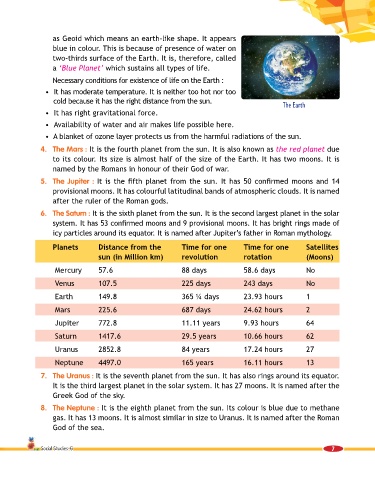
as Geoid which means an earth-like shape. It appears
                   blue in colour. This is because of presence of water on

                   two-thirds surface of the Earth. It is, therefore, called
                   a ‘Blue Planet’ which sustains all types of life.
                   Necessary conditions for existence of life on the Earth :

                 •   It has moderate temperature. It is neither too hot nor too
                   cold because it has the right distance from the sun.                            The Earth
                 •   It has right gravitational force.

                 •   Availability of water and air makes life possible here.
                 •   A blanket of ozone layer protects us from the harmful radiations of the sun.

               4.  The Mars : It is the fourth planet from the sun. It is also known as the red planet due
                   to its colour. Its size is almost half of the size of the Earth. It has two moons. It is
                   named by the Romans in honour of their God of war.

               5.  The Jupiter : It is the fifth planet from the sun. It has 50 confirmed moons and 14
                   provisional moons. It has colourful latitudinal bands of atmospheric clouds. It is named
                   after the ruler of the Roman gods.

               6.  The Saturn : It is the sixth planet from the sun. It is the second largest planet in the solar
                   system. It has 53 confirmed moons and 9 provisional moons. It has bright rings made of
                   icy particles around its equator. It is named after Jupiter’s father in Roman mythology.

                   Planets         Distance from the            Time for one         Time for one          Satellites
                                   sun (in Million km)          revolution           rotation              (Moons)

                    Mercury        57.6                         88 days              58.6 days             No

                    Venus          107.5                        225 days             243 days              No

                    Earth          149.8                        365 ¼ days           23.93 hours           1

                    Mars           225.6                        687 days             24.62 hours           2

                    Jupiter        772.8                        11.11 years          9.93 hours            64

                    Saturn         1417.6                       29.5 years           10.66 hours           62
                    Uranus         2852.8                       84 years             17.24 hours           27

                    Neptune        4497.0                       165 years            16.11 hours           13

               7.  The Uranus : It is the seventh planet from the sun. It has also rings around its equator.
                   It is the third largest planet in the solar system. It has 27 moons. It is named after the
                   Greek God of the sky.

               8.  The Neptune : It is the eighth planet from the sun. Its colour is blue due to methane
                   gas. It has 13 moons. It is almost similar in size to Uranus. It is named after the Roman
                   God of the sea.


               Social Studies-6                                                                                     7

