


Page 12 - sst_class_06
P. 12
Chapter  2            motion of the earth


             In ancient time, people believed that the earth was stationary
             and other heavenly bodies like the sun, moon moved around it.

             In the 16th century, Nicolaus Copernicus, a polish astronomer
             was the first to say that the earth is moving on its axis and also
             moving around the sun.

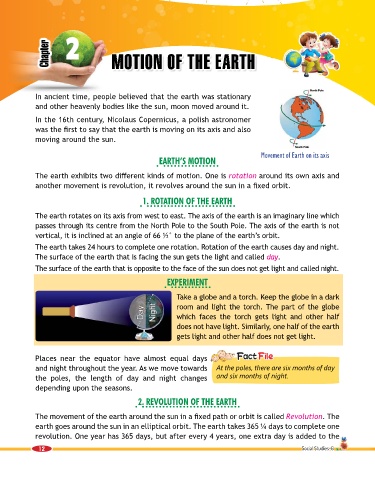
                                                                                           Movement of Earth on its axis
                                                        earth’S motion

             The earth exhibits two different kinds of motion. One is rotation around its own axis and
             another movement is revolution, it revolves around the sun in a fixed orbit.

                                                  1. rotation of the earth


             The earth rotates on its axis from west to east. The axis of the earth is an imaginary line which
             passes through its centre from the North Pole to the South Pole. The axis of the earth is not
             vertical, it is inclined at an angle of 66 ½° to the plane of the earth’s orbit.
             The earth takes 24 hours to complete one rotation. Rotation of the earth causes day and night.
             The surface of the earth that is facing the sun gets the light and called day.

             The surface of the earth that is opposite to the face of the sun does not get light and called night.

                                                           exPeriment

                                                              Take a globe and a torch. Keep the globe in a dark
                                                              room and light the torch. The part of the globe
                                                              which faces the torch gets light and other half
                                                              does not have light. Similarly, one half of the earth

                                                              gets light and other half does not get light.


             Places near  the  equator  have  almost equal days
             and night throughout the year. As we move towards  At the poles, there are six months of day
             the  poles, the  length of  day and  night  changes            and six months of night.

             depending upon the seasons.
                                                 2. revolution of the earth


             The movement of the earth around the sun in a fixed path or orbit is called Revolution. The
             earth goes around the sun in an elliptical orbit. The earth takes 365 ¼ days to complete one
             revolution. One year has 365 days, but after every 4 years, one extra day is added to the

              12                                                                                         Social Studies-6

