


Page 13 - sst_class_06
P. 13
month of February forming a leap year with 366 days.
             It happens because the six hours (¼th of 24 hours)

             make one day (24 hours) over a span of four years.
             This surplus day is added to the month of February.
             Thus,  every fourth year, February  has  29  days,  and
             such a year (with 366 days) is known as a leap year.


                                  DayS anD nightS

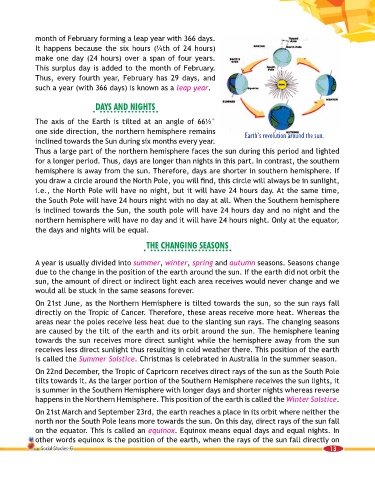
             The axis of the Earth is tilted at an angle of 66½°
             one side direction, the northern hemisphere remains                      Earth’s revolution around the sun.
             inclined towards the Sun during six months every year.

             Thus a large part of the northern hemisphere faces the sun during this period and lighted
             for a longer period. Thus, days are longer than nights in this part. In contrast, the southern
             hemisphere is away from the sun. Therefore, days are shorter in southern hemisphere. If
             you draw a circle around the North Pole, you will find, this circle will always be in sunlight,
             i.e., the North Pole will have no night, but it will have 24 hours day. At the same time,
             the South Pole will have 24 hours night with no day at all. When the Southern hemisphere
             is inclined towards the Sun, the south pole will have 24 hours day and no night and the
             northern hemisphere will have no day and it will have 24 hours night. Only at the equator,
             the days and nights will be equal.


                                                    the Changing SeaSonS


             A year is usually divided into summer, winter, spring and autumn seasons. Seasons change
             due to the change in the position of the earth around the sun. If the earth did not orbit the
             sun, the amount of direct or indirect light each area receives would never change and we
             would all be stuck in the same seasons forever.
             On 21st June, as the Northern Hemisphere is tilted towards the sun, so the sun rays fall
             directly on the Tropic of Cancer. Therefore, these areas receive more heat. Whereas the
             areas near the poles receive less heat due to the slanting sun rays. The changing seasons
             are caused by the tilt of the earth and its orbit around the sun. The hemisphere leaning
             towards the sun receives more direct sunlight while the hemisphere away from the sun
             receives less direct sunlight thus resulting in cold weather there. This position of the earth
             is called the Summer Solstice. Christmas is celebrated in Australia in the summer season.

             On 22nd December, the Tropic of Capricorn receives direct rays of the sun as the South Pole
             tilts towards it. As the larger portion of the Southern Hemisphere receives the sun lights, it
             is summer in the Southern Hemisphere with longer days and shorter nights whereas reverse
             happens in the Northern Hemisphere. This position of the earth is called the Winter Solstice.

             On 21st March and September 23rd, the earth reaches a place in its orbit where neither the
             north nor the South Pole leans more towards the sun. On this day, direct rays of the sun fall
             on the equator. This is called an equinox. Equinox means equal days and equal nights. In
             other words equinox is the position of the earth, when the rays of the sun fall directly on
               Social Studies-6                                                                                    13

