


Page 5 - sst_class_06
P. 5
Unit-i : geography
                  Chapter  1           the earth in the


                                       solar system


             Sky is an endless ceiling, where we see many shiny objects. All these objects are called
             celestial  bodies  or  heavenly  bodies.  The  heavenly  bodies  include  the  stars,  planets,
             satellites, asteroids, comets, meteors, etc. The sun is also a star and our Earth is a planet.
                                                               StarS


             The celestial bodies which have their own light, are called stars. Stars are made of hot and glowing
             gases and produce heat and light. Stars look very small because they are so far away from us.
             The sun looks bigger than other stars because it is closer to the earth.

             Our sun and all the stars belong to a galaxy. There are millions of galaxies in the universe.
             Our solar system belongs to the Milky Way Galaxy, popularly known as the Milky Way (Akash
             Ganga). The Milky Way has about 10,000 crore stars. Short astronomical distances, such as the
             distance from the earth to the sun, can be measured in kilometres. The distance is equal to
             148,800,000 kilometres. But even the kilometre is too small to measure the distance between
             stars. So astronomers use a unit of distance called the light year for this purpose. A light year
             is the distance light travels in one year. Light travels at about 300,000 kilometres per second.
             So in one year, light travels a distance of about 9.5 trillion kilometres.

             Calculating distance of 1 light year

             distance       =   (  300,000       ×      60       ×      60      ×      24      ×   365)


                                    Speed              1 min           1 hr          1 day        1 year
                                per second
                                            = 9.4608 × 10¹² km                    Earlier,  Pluto  was ninth  planet

                                            = 9.5 trillion km (rounded up)        of our solar system, but now it is
                                                                                  considered as a dwarf planet.
                                                        the Solar SyStem


             The solar system consists of the sun, the eight planets, their satellites and thousands of
             other smaller bodies. The four planets that are nearest to the sun, are called inner planets.
             In order from the sun, they are Mercury, Venus, Earth and Mars. Jupiter, Saturn, Uranus
             and Neptune are outer planets. Mercury is closest to the sun and has almost no atmosphere
             because it has been burned off

             by the Sun. Venus is considered
             as Earth’s twin  because  its
             size and shape are very much
             similar to that of the Earth.
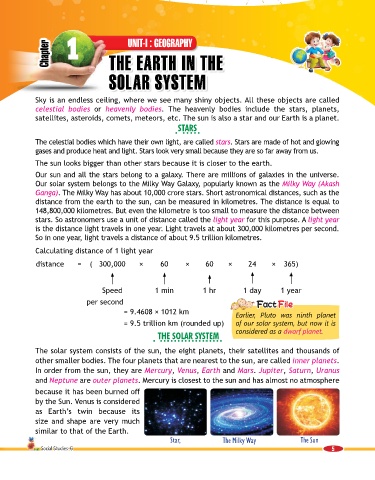
                                                            Star,             The Milky Way              The Sun
               Social Studies-6                                                                                     5

