


Page 14 - sst_class_06
P. 14
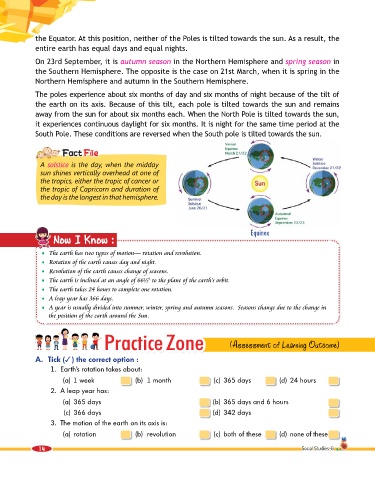
the Equator. At this position, neither of the Poles is tilted towards the sun. As a result, the
entire earth has equal days and equal nights.
On 23rd September, it is autumn season in the Northern Hemisphere and spring season in
the Southern Hemisphere. The opposite is the case on 21st March, when it is spring in the
Northern Hemisphere and autumn in the Southern Hemisphere.
The poles experience about six months of day and six months of night because of the tilt of
the earth on its axis. Because of this tilt, each pole is tilted towards the sun and remains
away from the sun for about six months each. When the North Pole is tilted towards the sun,
it experiences continuous daylight for six months. It is night for the same time period at the
South Pole. These conditions are reversed when the South pole is tilted towards the sun.
A solstice is the day, when the midday
sun shines vertically overhead at one of
the tropics, either the tropic of cancer or
the tropic of Capricorn and duration of
the day is the longest in that hemisphere.
Equinox
Now I Know :
The earth has two types of motion— rotation and revolution.
Rotation of the earth causes day and night.
Revolution of the earth causes change of seasons.
The earth is inclined at an angle of 66½° to the plane of the earth’s orbit.
The earth takes 24 hours to complete one rotation.
A leap year has 366 days.
A year is usually divided into summer, winter, spring and autumn seasons. Seasons change due to the change in
the position of the earth around the Sun.
(Assessment of Learning Outcome)
A. Tick () the correct option :
1. Earth’s rotation takes about:
(a) 1 week (b) 1 month (c) 365 days (d) 24 hours
2. A leap year has:
(a) 365 days (b) 365 days and 6 hours
(c) 366 days (d) 342 days
3. The motion of the earth on its axis is:
(a) rotation (b) revolution (c) both of these (d) none of these
14 Social Studies-6

