


Page 81 - sst_class_07
P. 81
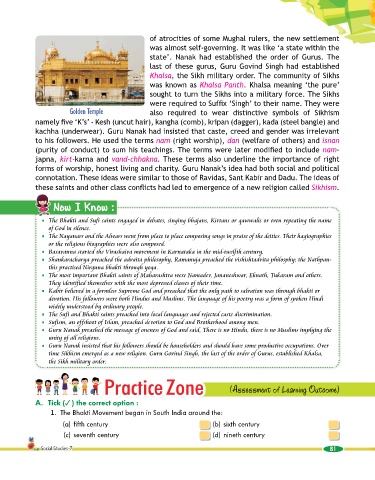
of atrocities of some Mughal rulers, the new settlement
was almost self-governing. It was like ‘a state within the
state’. Nanak had established the order of Gurus. The
last of these gurus, Guru Govind Singh had established
Khalsa, the Sikh military order. The community of Sikhs
was known as Khalsa Panth. Khalsa meaning ‘the pure’
sought to turn the Sikhs into a military force. The Sikhs
were required to Suffix ‘Singh’ to their name. They were
Golden Temple also required to wear distinctive symbols of Sikhism
namely five ‘K’s’ - Kesh (uncut hair), kangha (comb), kripan (dagger), kada (steel bangle) and
kachha (underwear). Guru Nanak had insisted that caste, creed and gender was irrelevant
to his followers. He used the terms nam (right worship), dan (welfare of others) and isnan
(purity of conduct) to sum his teachings. The terms were later modified to include nam-
japna, kirt-karna and vand-chhakna. These terms also underline the importance of right
forms of worship, honest living and charity. Guru Nanak’s idea had both social and political
connotation. These ideas were similar to those of Ravidas, Sant Kabir and Dadu. The ideas of
these saints and other class conflicts had led to emergence of a new religion called Sikhism.
Now I Know :
The Bhakti and Sufi saints engaged in debates, singing bhajans, Kirtans or qawwalis or even repeating the name
of God in silence.
The Nayanars and the Alwars went from place to place composing songs in praise of the deities. Their hagiographies
or the religious biographies were also composed.
Basavanna started the Virashaiva movement in Karnataka in the mid-twelfth century.
Shankaracharya preached the advaita philosophy, Ramanuja preached the vishishtadvita philosphy; the Nathpan-
this practised Nirguna bhakti through yoga.
The most important Bhakti saints of Maharashtra were Namadev, Jananeshwar, Eknath, Tukaram and others.
They identified themselves with the most depressed classes of their time.
Kabir believed in a formless Supreme God and preached that the only path to salvation was through bhakti or
devotion. His followers were both Hindus and Muslims. The language of his poetry was a form of spoken Hindi
widely understood by ordinary people.
The Sufi and Bhakti saints preached into local languages and rejected caste discrimination.
Sufism, an offshoot of Islam, preached devotion to God and Brotherhood among men.
Guru Nanak preached the message of oneness of God and said, There is no Hindu, there is no Muslims implying the
unity of all religions.
Guru Nanak insisted that his followers should be householders and should have some productive occupations. Over
time Sikhism emerged as a new religion. Guru Govind Singh, the last of the order of Gurus, established Khalsa,
the Sikh military order.
(Assessment of Learning Outcome)
A. Tick () the correct option :
1. The Bhakti Movement began in South India around the:
(a) fifth century (b) sixth century
(c) seventh century (d) nineth century
Social Studies-7 81

