


Page 84 - sst_class_07
P. 84
powerful and quite independent states. But, the rulers of these states did not break their

             formal relations with the Mughal emperor. They had occupied high Mansabdari positions
             and enjoyed the trust and confidence of the emperors.
                                                             bengal

                                    The territory comprising modern West Bengal, Bangladesh and parts of

                                    Assam, Orissa, Bihar and Jharkhand was a province of Mughal Empire.
                                    The Governor as in Awadh, was known as a Nawab. Following decline
                                    of  the Mughal Empire, it sought independence  from  the  Mughals  on
                                    payment of tribute. Murshid Quli Khan had been appointed as the naib to
                                    the governor of the province. He quickly rose in ranks and seized all the
                                    power. He controlled over local resources and revenue administration
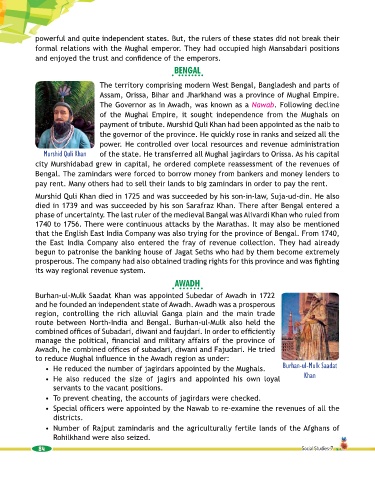
                Murshid Quli Khan   of the state. He transferred all Mughal jagirdars to Orissa. As his capital
             city Murshidabad grew in capital, he ordered complete reassessment of the revenues of
             Bengal. The zamindars were forced to borrow money from bankers and money lenders to

             pay rent. Many others had to sell their lands to big zamindars in order to pay the rent.
             Murshid Quli Khan died in 1725 and was succeeded by his son-in-law, Suja-ud-din. He also
             died in 1739 and was succeeded by his son Sarafraz Khan. There after Bengal entered a
             phase of uncertainty. The last ruler of the medieval Bangal was Alivardi Khan who ruled from
             1740 to 1756. There were continuous attacks by the Marathas. It may also be mentioned
             that the English East India Company was also trying for the province of Bengal. From 1740,
             the East India Company also entered the fray of revenue collection. They had already
             begun to patronise the banking house of Jagat Seths who had by them become extremely
             prosperous. The company had also obtained trading rights for this province and was fighting
             its way regional revenue system.

                                                             awadh

             Burhan-ul-Mulk Saadat Khan was appointed Subedar of Awadh in 1722
             and he founded an independent state of Awadh. Awadh was a prosperous
             region, controlling the  rich alluvial  Ganga  plain  and  the  main  trade
             route between North-India and Bengal. Burhan-ul-Mulk  also held the
             combined offices of Subadari, diwani and faujdari. In order to efficiently
             manage the political, financial and military affairs of the province of
             Awadh, he combined offices of subadari, diwani and Fajudari. He tried
             to reduce Mughal influence in the Awadh region as under:
                 •  He reduced the number of jagirdars appointed by the Mughals.                   Burhan-ul-Mulk Saadat

                 •  He  also reduced  the  size of jagirs and  appointed  his  own loyal                  Khan
                   servants to the vacant positions.
                 •  To prevent cheating, the accounts of jagirdars were checked.
                 •  Special officers were appointed by the Nawab to re-examine the revenues of all the
                   districts.
                 •  Number of Rajput zamindaris and the agriculturally fertile lands of the Afghans of
                   Rohilkhand were also seized.

              84                                                                                         Social Studies-7

