


Page 76 - sst_class_07
P. 76
few women also. They often criticised the Buddhists and Jainas. They composed poems in

             Sangam literature (Tamil Literature) and set them to music. They went from place to place
             to spread the movement. During the 10th and 12th centuries, the Chola and Pandya kings
             built many temples and promoted the Bhakti Movement. During this period. Hagiographies
             or religious biographies of the Nayanars and Alwars were also composed. These are now used
             as sources of History to know about the Bhakti Movement of South India.

             shankaRaChaRya

             Shankaracharya,  an  eighth-century  saint  of  South  Indian,  preached  the
             advaita philosophy, that is, understanding and uniting with the universal soul
             called  Brahma  through  the  attainment  of  knowledge.  Shankaracharya  set
             up mathas (centres of learning and worship) at Badrinath, Puri, Dwarka and
             Shringeri. These mathas grew into important pilgrimage centres.
                                                                                                         Shankaracharya
                             Ramanuja

                             Ramanuja was born in Tamil Nadu in the eleventh century. He was deeply
                             influenced by the Alwars. He was an advocate of the doctrine of Vishista-
                             davita (qualified non-dualism). He believed that the best means of attaining
                             salvation was through intense devotion to Vishnu. According to Ramanuja’s

                Ramanuja     teachings, Lord Narayana or Bhagavah is the Supreme Being.

             basavanna

             Basavanna initiated the Virashaiva Movement or Virashaivism. This movement
             began in Karnataka in mid-twelfth century. This movement advocated for
             the  quality  of all  human  beings.  The  Virashaivas  strongly  criticised  the
             Brahmanical ideas about caste and the treatment of women. They were also
             against all forms of ritual and idol worship. Allama Prabhu and Akkamahadevi
             were other important religious leaders of Virashaivish.                                        Ramanuja

                                                   sainTs Of maharashTra
             The Vaishnava saints of Maharashtra, called Varakaris, were worshipper of Lord Vitthala
             (Vishnu) of Pandharpur. Jananeshwar, Namadeva, Tukaram and Ekanath were among the
             saints who popularised Vitthala worship. They were family men, and did not give up worldly
             life.  They  rejected  rituals  and  composed devotional  poems called  abhangs  in Marathi
             language. Jananeshwar wrote Jananeshwari, a Marathi commentary on the Bhagavadgita.


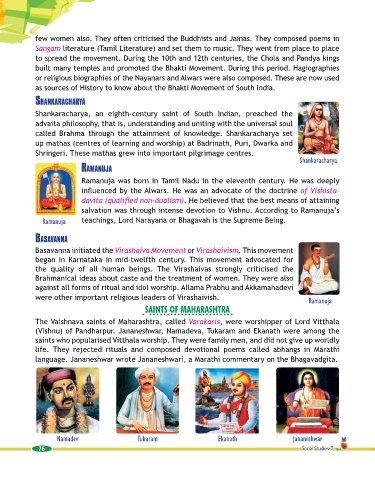
                     Namadev                     Tukaram                    Ekanath                   Jananeshwar
              76                                                                                         Social Studies-7

