


Page 86 - sst_class_07
P. 86
their own states. They also began to participate in Mughal court
                                             intrigues. Some of them won important posts in this process,
                                             and became quite powerful. For example, Maharaja Ajit Singh
                                             of Jodhpur became the governor of Ajmer and Gujarat, and
                                             Maharaja Jai Singh II of Amber, also known as Sawai Raja Jai
                                             Singh, became the governor of Malwa and Agra.
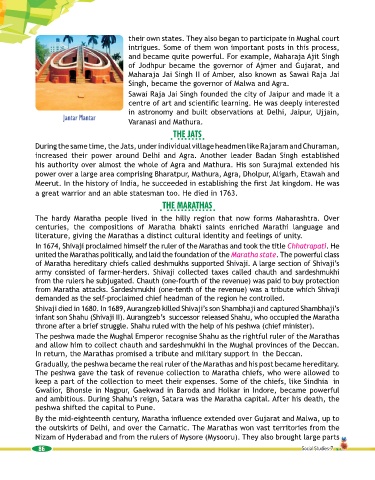
                                             Sawai Raja Jai Singh founded the city of Jaipur and made it a
                                             centre of art and scientific learning. He was deeply interested
                                             in astronomy and built observations at Delhi, Jaipur, Ujjain,
                       Jantar Mantar
                                             Varanasi and Mathura.

                                                             The jaTs
             During the same time, the Jats, under individual village headmen like Rajaram and Churaman,
             increased  their  power  around  Delhi  and Agra. Another  leader  Badan  Singh  established
             his authority over almost the whole of Agra and Mathura. His son Surajmal extended his
             power over a large area comprising Bharatpur, Mathura, Agra, Dholpur, Aligarh, Etawah and
             Meerut. In the history of India, he succeeded in establishing the first Jat kingdom. He was

             a great warrior and an able statesman too. He died in 1763.
                                                         The maraThas

             The hardy Maratha  people lived in  the  hilly region that  now forms  Maharashtra.  Over
             centuries,  the  compositions  of  Maratha  bhakti  saints  enriched  Marathi  language  and
             literature, giving the Marathas a distinct cultural identity and feelings of unity.
             In 1674, Shivaji proclaimed himself the ruler of the Marathas and took the title Chhatrapati. He
             united the Marathas politically, and laid the foundation of the Maratha state. The powerful class
             of Maratha hereditary chiefs called deshmukhs supported Shivaji. A large section of Shivaji’s
             army consisted of farmer-herders. Shivaji collected taxes called chauth and sardeshmukhi
             from the rulers he subjugated. Chauth (one-fourth of the revenue) was paid to buy protection
             from Maratha attacks. Sardeshmukhi (one-tenth of the revenue) was a tribute which Shivaji
             demanded as the self-proclaimed chief headman of the region he controlled.

             Shivaji died in 1680. In 1689, Aurangzeb killed Shivaji’s son Shambhaji and captured Shambhaji’s
             infant son Shahu (Shivaji II). Aurangzeb’s  successor released Shahu, who occupied the Maratha
             throne after a brief struggle. Shahu ruled with the help of his peshwa (chief minister).

             The peshwa made the Mughal Emperor recognise Shahu as the rightful ruler of the Marathas
             and allow him to collect chauth and sardeshmukhi in the Mughal provinces of the Deccan.
             In return, the Marathas promised a tribute and military support in  the Deccan.

             Gradually, the peshwa became the real ruler of the Marathas and his post became hereditary.
             The peshwa gave the task of revenue collection to Maratha chiefs, who were allowed to
             keep a part of the collection to meet their expenses. Some of the chiefs, like Sindhia  in
             Gwalior, Bhonsle in Nagpur, Gaekwad in Baroda and Holkar in Indore, became powerful
             and ambitious. During Shahu’s reign, Satara was the Maratha capital. After his death, the
             peshwa shifted the capital to Pune.
             By the mid-eighteenth century, Maratha influence extended over Gujarat and Malwa, up to
             the outskirts of Delhi, and over the Carnatic. The Marathas won vast territories from the
             Nizam of Hyderabad and from the rulers of Mysore (Mysooru). They also brought large parts

              86                                                                                         Social Studies-7

