


Page 79 - sst_class_07
P. 79
The word ‘Sufi’ is derived from suf, meaning wool, The Sufis were so called because they

              wore coarse garments made of wool. They led simple lives in Khanqahs (hermitages),
              which resembled monasteries. People from all walks of life gathered at the Khanqahs for
              collective devotional singing, spiritual discussions and getting advice on their problems.
              The Sufis gave a lot of importance to the relation between the pir (religious teacher) and

              his disciples. The pir trained his disciples in practices such as zikr (chanting of name),
              penance,  fasting, holding of breath and sama— a form of devotional singing. The pir
              chose a successor to carry on his work.

              After the Turkish invasions of the early medieval period, many Sufis came to India.
              Teachings : The Sufis preached devotion to God, brotherhood among men and kindness
              towards fellow beings. They believed in one god. They accepted that there could be

              many ways of reaching God. Hence, they were tolerant of other religions.
              The Sufis mixed freely with all sections of the society and preached in the local languages.

              Sufi orders :  The  Sufis  were  organised  in  several  silsilahs
              (orders), each with its distinctive tariqat (method of instruction
              and rituals). The Chishti and the Suhrawardi silsilahs became

              popular in India. The Chishti order was established in India
              by Khwaja Muin-ud-din Chishti, who had his headquarters in
              Ajmer. Shaikh Baha-ud-din Zakariya established the Suhrawardi
              order in India. This order was popular in Punjab and Multan.
              While the Chishtis kept away from politics, the Suhrawardis
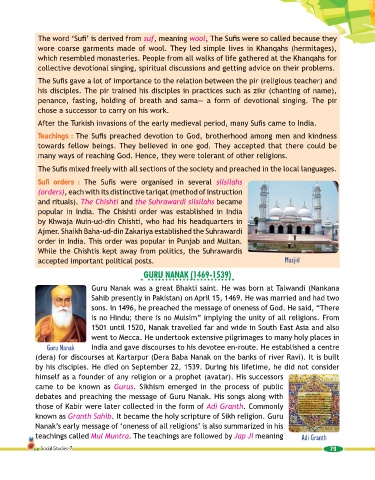
              accepted important political posts.                                                  Masjid

                                                   guru nanaK (1469-1539)

                                 Guru Nanak was a great Bhakti saint. He was born at Talwandi (Nankana
                                 Sahib presently in Pakistan) on April 15, 1469. He was married and had two
                                 sons. In 1496, he preached the message of oneness of God. He said, “There

                                 is no Hindu; there is no Mulsim” implying the unity of all religions. From
                                 1501 until 1520, Nanak travelled far and wide in South East Asia and also
                                 went to Mecca. He undertook extensive pilgrimages to many holy places in
                 Guru Nanak      India and gave discourses to his devotee en-route. He established a centre
             (dera) for discourses at Kartarpur (Dera Baba Nanak on the banks of river Ravi). It is built
             by his disciples. He died on September 22, 1539. During his lifetime, he did not consider
             himself as a founder of any religion or a prophet (avatar). His successors
             came to be known as  Gurus. Sikhism emerged in the process of public
             debates and preaching the message of Guru Nanak. His songs along with

             those of Kabir were later collected in the form of Adi Granth. Commonly
             known as Granth Sahib. It became the holy scripture of Sikh religion. Guru
             Nanak’s early message of ‘oneness of all religions’ is also summarized in his
             teachings called Mul Muntra. The teachings are followed by Jap Ji meaning                   Adi Granth

               Social Studies-7                                                                                    79

