


Page 85 - sst_class_07
P. 85
The state was dependent on local bankers and mahajans for loans. So it sold the right to
             collect tax to the highest bidders and the “revenue farmers” (ijaradars) agreed to pay the
             state a fixed sum of money. In turn, the revenue farmers were given considerable freedom
             in the assessment and collection of taxes. This way moneylenders and bankers got right to

             influence the management of the state’s revenue system.
                                                           hyderabad

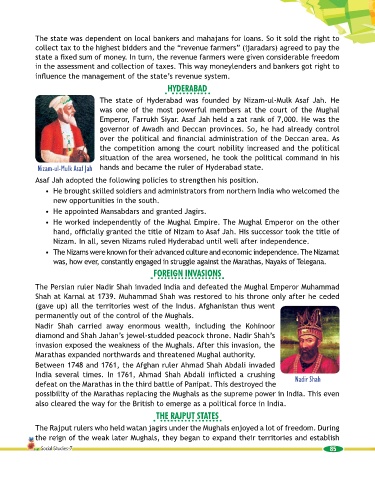
                                    The state  of Hyderabad was founded by Nizam-ul-Mulk Asaf Jah. He
                                    was one of  the  most powerful members at the  court of  the  Mughal
                                    Emperor, Farrukh Siyar. Asaf Jah held a zat rank of 7,000. He was the
                                    governor of Awadh and Deccan provinces. So, he had already control
                                    over the political and financial administration of the Deccan area. As
                                    the competition among the court nobility increased and the political
                                    situation of the area worsened, he took the political command in his
              Nizam-ul-Mulk Asaf Jah  hands and became the ruler of Hyderabad state.

             Asaf Jah adopted the following policies to strengthen his position.
                 •  He brought skilled soldiers and administrators from northern India who welcomed the
                   new opportunities in the south.

                 •  He appointed Mansabdars and granted Jagirs.
                 •  He worked independently of the Mughal Empire. The Mughal Emperor on the other
                   hand, officially granted the title of Nizam to Asaf Jah. His successor took the title of
                   Nizam. In all, seven Nizams ruled Hyderabad until well after independence.
                 •  The Nizams were known for their advanced culture and economic independence. The Nizamat

                   was, how ever, constantly engaged in struggle against the Marathas, Nayaks of Telegana.
                                                      fOreign invasiOns

             The Persian ruler Nadir Shah invaded India and defeated the Mughal Emperor Muhammad
             Shah at Karnal at 1739. Muhammad Shah was restored to his throne only after he ceded
             (gave up) all the territories west of the Indus. Afghanistan thus went
             permanently out of the control of the Mughals.
             Nadir Shah carried away  enormous wealth,  including  the  Kohinoor
             diamond and Shah Jahan’s jewel-studded peacock throne. Nadir Shah’s
             invasion exposed the weakness of the Mughals. After this invasion, the

             Marathas expanded northwards and threatened Mughal authority.
             Between 1748 and 1761, the Afghan ruler Ahmad Shah Abdali invaded
             India  several  times.  In  1761, Ahmad  Shah Abdali  inflicted  a  crushing              Nadir Shah
             defeat on the Marathas in the third battle of Panipat. This destroyed the
             possibility of the Marathas replacing the Mughals as the supreme power in India. This even
             also cleared the way for the British to emerge as a political force in India.
                                                       The rajPuT sTaTes

             The Rajput rulers who held watan jagirs under the Mughals enjoyed a lot of freedom. During
             the reign of the weak later Mughals, they began to expand their territories and establish

               Social Studies-7                                                                                    85

