


Page 78 - sst_class_07
P. 78
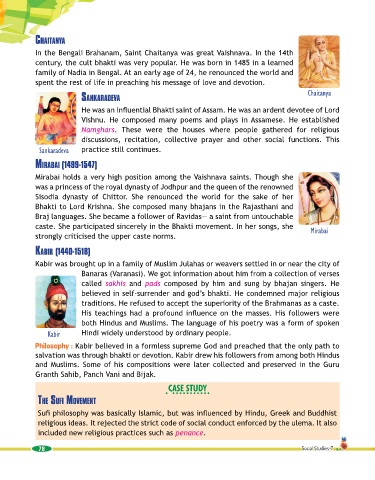
Chaitanya
             In the Bengali Brahanam, Saint Chaitanya was great Vaishnava. In the 14th
             century, the cult bhakti was very popular. He was born in 1485 in a learned

             family of Nadia in Bengal. At an early age of 24, he renounced the world and
             spent the rest of life in preaching his message of love and devotion.
                                                                                                           Chaitanya
                             sankaRadeva

                             He was an influential Bhakti saint of Assam. He was an ardent devotee of Lord
                             Vishnu.  He  composed many  poems and  plays in Assamese.  He  established
                             Namghars.  These were the  houses where people gathered  for  religious
                             discussions,  recitation,  collective  prayer  and  other  social functions.  This
               Sankaradeva   practice still continues.

             miRabai (1499-1547)

             Mirabai holds a very high position among the Vaishnava saints. Though she
             was a princess of the royal dynasty of Jodhpur and the queen of the renowned

             Sisodia dynasty  of  Chittor. She  renounced  the  world  for  the  sake  of  her
             Bhakti to Lord Krishna. She composed many bhajans in the Rajasthani and
             Braj languages. She became a follower of Ravidas— a saint from untouchable
             caste. She participated sincerely in the Bhakti movement. In her songs, she                    Mirabai
             strongly criticised the upper caste norms.

             kabiR (1440-1518)

             Kabir was brought up in a family of Muslim Julahas or weavers settled in or near the city of
                             Banaras (Varanasi). We got information about him from a collection of verses
                             called  sakhis  and  pads  composed by  him  and  sung  by  bhajan  singers. He
                             believed in self-surrender and god’s bhakti. He condemned major religious
                             traditions. He refused to accept the superiority of the Brahmanas as a caste.
                             His teachings had a profound influence on the masses. His followers were

                             both Hindus and Muslims. The language of his poetry was a form of spoken
                  Kabir      Hindi widely understood by ordinary people.

             Philosophy : Kabir believed in a formless supreme God and preached that the only path to
             salvation was through bhakti or devotion. Kabir drew his followers from among both Hindus
             and Muslims. Some of his compositions were later collected and preserved in the Guru
             Granth Sahib, Panch Vani and Bijak.
                                                           case sTudy


              the sufi movement
              Sufi philosophy was basically Islamic, but was influenced by Hindu, Greek and Buddhist
              religious ideas. It rejected the strict code of social conduct enforced by the ulema. It also
              included new religious practices such as penance.


              78                                                                                         Social Studies-7

