


Page 60 - sst_class_07
P. 60
TughluQ dynasTy (1320-1414)

             Ghiyasuddin was an efficient and experienced administrator and able military commander.
             He liberlised various harsh measures imposed by Alauddin Khalji and restored peace and
             order in the kingdom. He built the fortified city of Tughlaqabad in Delhi. He died in an
             accident in 1325.

                                          muhammad-bin TughluQ (1325-1351)

                                  Muhammad-bin Tughluq laid stress on merit and raised many people of
                                  humble origins to high postition. This offended many of the nobles and
                                  they refused to cooperate with him. Muhammad-bin-Tughluq made grand
                                  plans and introduced many new policies, but these were not carried out
                                  properly. These failed experiments lowered his prestige. Revolts broke out
                                  in many parts of his empire and provinces began to break away. He shifted
                                  his capital from Delhi to Devagiri in 1327 AD. Muhammad-bin-Tughluq died
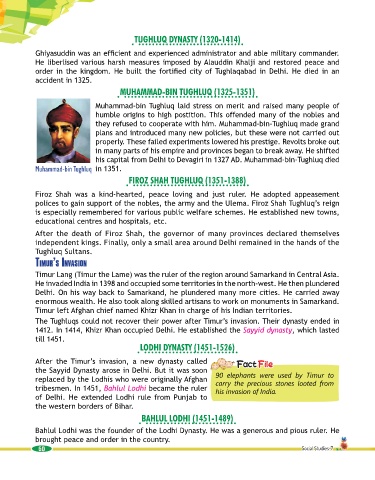
             Muhammad-bin Tughluq  in 1351.

                                              firOz shah TughluQ (1351-1388)

             Firoz  Shah  was  a  kind-hearted,  peace  loving  and  just  ruler. He  adopted  appeasement
             polices to gain support of the nobles, the army and the Ulema. Firoz Shah Tughluq’s reign
             is especially remembered for various public welfare schemes. He established new towns,
             educational centres and hospitals, etc.
             After the death of Firoz Shah, the governor of many provinces declared themselves
             independent kings. Finally, only a small area around Delhi remained in the hands of the
             Tughluq Sultans.

             timuR’s invasion
             Timur Lang (Timur the Lame) was the ruler of the region around Samarkand in Central Asia.
             He invaded India in 1398 and occupied some territories in the north-west. He then plundered
             Delhi. On his way back to Samarkand, he plundered many more cities. He carried away
             enormous wealth. He also took along skilled artisans to work on monuments in Samarkand.
             Timur left Afghan chief named Khizr Khan in charge of his Indian territories.
             The Tughluqs could not recover their power after Timur’s invasion. Their dynasty ended in
             1412. In 1414, Khizr Khan occupied Delhi. He established the Sayyid dynasty, which lasted
             till 1451.
                                                 lOdhi dynasTy (1451-1526)

             After the  Timur’s invasion, a new  dynasty  called
             the Sayyid Dynasty arose in Delhi. But it was soon
             replaced by the Lodhis who were originally Afghan              90 elephants were used by Timur  to
                                                                            carry the precious stones looted from
             tribesmen. In 1451, Bahlul Lodhi became the ruler              his invasion of India.
             of Delhi. He extended Lodhi rule from Punjab to
             the western borders of Bihar.
                                                  bahlul lOdhi (1451-1489)

             Bahlul Lodhi was the founder of the Lodhi Dynasty. He was a generous and pious ruler. He
             brought peace and order in the country.
              60                                                                                         Social Studies-7

