


Page 58 - sst_class_07
P. 58
Chapter  10            THe delHi sUlTanaTe


             For more than 150 years after the raids of Mahmud of Ghanzi, India did not face any major
             invasion. During this period, the Rajput rulers of North India promoted trade with the Muslims.
             Some Muslim traders even settled in India. The Sufis also began to enter India around this time.


                Apart from coins, monuments and inscription, one of the main sources of information about the
                Delhi Sultanate are the tawarikh or historical accounts written by courtiers, poets and other learned
                men who lived in the cities.

                                             The slave dynasTy (1206-1290 ad)


             The first dynasty of the Delhi sultanate was called the
             Slave or  Mamluk  Dynasty.  The word  Mamluk  in Arabic
             means  an  individual  owned  by  someone  else.  All the
             important  rulers of  this  dynasty  such  as Iltutmish  and
             Balban were slaves before they became sultans.
             IItumish  and  Balban  were slaves of  Qutb-ud-din Aibak,
             who himself was a slave of Muhammad Ghori.                             Qutb-din-Aibak      Qutab minar

                                              QuTub-ud-din aibaK (1206-1210)

             Qutb-Ud-Din strengthened his position by being generous to his subjects and by entering
             into marriage alliances.

             Qutb-ud-din built India’s oldest masjid (mosque) the Quwwat-ul-Islam Masjid in Delhi. A
             masjid is a place of Islamic worship. Masjid means a place where people prostrate (lie flat
             on the face) in worship.

                                            shamsuddin ilTuTmish (1211-1236)

             Iltutmish was a slave and son-in-law of Qutb-ud-din Aibak. He succeeded Aram Shah and
             ruled for about 25 years.

             He organised the army and administered his Sultanate efficiently. He also introduced the
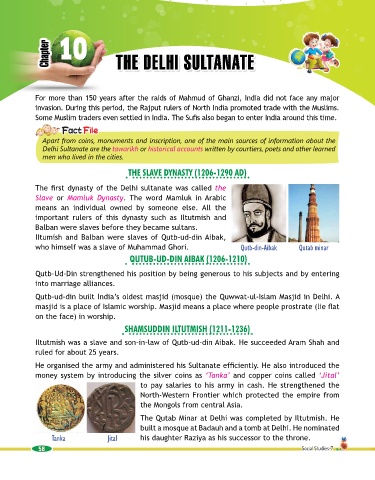
             money system by introducing the silver coins as ‘Tanka’ and copper coins called ‘Jital’
                                                  to pay salaries to his army in cash. He strengthened the
                                                  North-Western Frontier which protected the empire from
                                                  the Mongols from central Asia.

                                                  The Qutab Minar at Delhi was completed by Iltutmish. He
                                                  built a mosque at Badauh and a tomb at Delhi. He nominated

                   Tanka              Jital       his daughter Raziya as his successor to the throne.
              58                                                                                         Social Studies-7

