


Page 64 - sst_class_07
P. 64
Chapter  11            THe mUgHal empire


             The Mughals were the descendents of the two great rulers of Central Asia from their mother’s
             side they were the descendants of – Changez Khan who ruled over Mongol tribes, China and
             some other parts of Central Asia, and from their father’s side, they were the successors of
             Timur—the ruler of Iran, Iraq and modern Turkey, who had attacked Delhi in 1398.
             The Mughal empire was founded in India by Zahir-ud-din Mahummad Babur in 1526.

                                                    sher shah (1540-1545)

                 •  Sher Shah’s childhood name was Farid.
                 •  Sher Shah was born to Hasan, the Jagirdar of Sasaram.
                 •  He received the title of Sher Shah from Bahar Khan
                   Lohani , the Afghan Governor of South Bihar.
                 •  Sher Shah gained Chunar by marrying the widow,
                   Malika.
                 •  He defeated Humayun in the battle of Chausa.
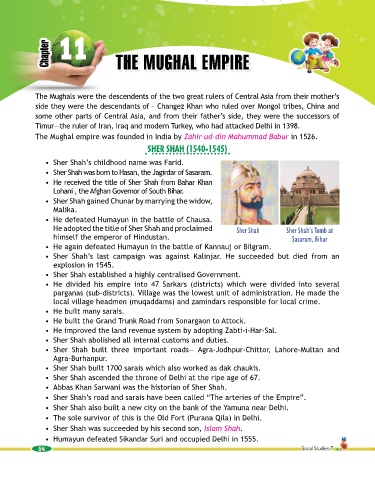
                   He adopted the title of Sher Shah and proclaimed                Sher Shah        Sher Shah’s Tomb at
                   himself the emperor of Hindustan.                                                  Sasaram, Bihar
                 •  He again defeated Humayun in the battle of Kannauj or Bilgram.
                 •  Sher  Shah’s last  campaign  was  against  Kalinjar.  He  succeeded  but  died  from an
                   explosion in 1545.
                 •  Sher Shah established a highly centralised Government.
                 •  He  divided his empire into  47  Sarkars (districts)  which  were  divided  into  several
                   parganas (sub-districts). Village was the lowest unit of administration. He made the
                   local village headmen (muqaddams) and zamindars responsible for local crime.
                 •  He built many sarais.
                 •  He built the Grand Trunk Road from Sonargaon to Attock.
                 •  He improved the land revenue system by adopting Zabti-i-Har-Sal.
                 •  Sher Shah abolished all internal customs and duties.
                 •  Sher Shah  built  three important  roads—  Agra-Jodhpur-Chittor, Lahore-Multan  and
                   Agra-Burhanpur.
                 •  Sher Shah built 1700 sarais which also worked as dak chaukis.
                 •  Sher Shah ascended the throne of Delhi at the ripe age of 67.
                 •  Abbas Khan Sarwani was the historian of Sher Shah.

                 •  Sher Shah’s road and sarais have been called “The arteries of the Empire”.
                 •  Sher Shah also built a new city on the bank of the Yamuna near Delhi.
                 •  The sole survivor of this is the Old Fort (Purana Qila) in Delhi.
                 •  Sher Shah was succeeded by his second son, Islam Shah.

                 •  Humayun defeated Sikandar Suri and occupied Delhi in 1555.
              64                                                                                         Social Studies-7

