


Page 61 - sst_class_07
P. 61
He got the throne of Delhi from the last Sayyid ruler All-ud-din
             Alam Shah. Before that he was a Sayyid Subedar of Lahore. He
             conquered the territories around Delhi.

             He fought continuously for 26 years and succeeded in extending his
             authority over Jaunpur, Rewali, Itawa, Mewar, Sambhal and Gwalior.
             He was always ready to help his people. Though he was illiterate, he

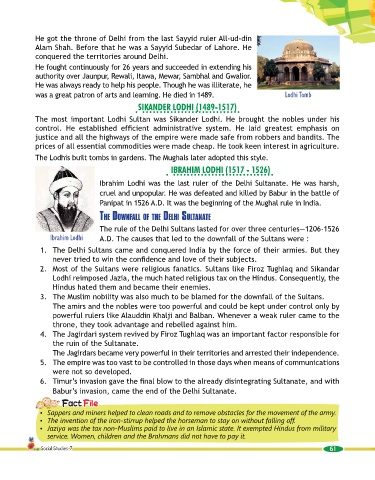
             was a great patron of arts and learning. He died in 1489.                              Lodhi Tomb
                                                 siKander lOdhi (1489-1517)

             The most important Lodhi Sultan was Sikander Lodhi. He brought the nobles under his
             control.  He  established  efficient  administrative  system.  He  laid  greatest  emphasis  on
             justice and all the highways of the empire were made safe from robbers and bandits. The
             prices of all essential commodities were made cheap. He took keen interest in agriculture.

             The Lodhis built tombs in gardens. The Mughals later adopted this style.
                                                            ibrahim lOdhi (1517 - 1526)

                                   Ibrahim Lodhi was the last ruler of the Delhi Sultanate. He was harsh,

                                   cruel and unpopular. He was defeated and killed by Babur in the battle of
                                   Panipat in 1526 A.D. It was the beginning of the Mughal rule in India.

                                   the doWnfall of the delhi sultanate
                                   The rule of the Delhi Sultans lasted for over three centuries—1206-1526
                  Ibrahim Lodhi    A.D. The causes that led to the downfall of the Sultans were :

               1.  The Delhi Sultans came and conquered India by the force of their armies. But they
                   never tried to win the confidence and love of their subjects.
               2.  Most of the Sultans were religious fanatics. Sultans like Firoz Tughlaq and Sikandar
                   Lodhi reimposed Jazia, the much hated religious tax on the Hindus. Consequently, the
                   Hindus hated them and became their enemies.
               3.  The Muslim nobility was also much to be blamed for the downfall of the Sultans.
                   The amirs and the nobles were too powerful and could be kept under control only by
                   powerful rulers like Alauddin Khalji and Balban. Whenever a weak ruler came to the
                   throne, they took advantage and rebelled against him.
               4.  The Jagirdari system revived by Firoz Tughlaq was an important factor responsible for
                   the ruin of the Sultanate.
                   The Jagirdars became very powerful in their territories and arrested their independence.
               5.  The empire was too vast to be controlled in those days when means of communications
                   were not so developed.
               6.  Timur’s invasion gave the final blow to the already disintegrating Sultanate, and with
                   Babur’s invasion, came the end of the Delhi Sultanate.


               •  Sappers and miners helped to clean roads and to remove obstacles for the movement of the army.
               •  The invention of the iron-stirrup helped the horseman to stay on without falling off.
               •  Jaziya was the tax non-Muslims paid to live in an Islamic state. It exempted Hindus from military
                 service. Women, children and the Brahmans did not have to pay it.

               Social Studies-7                                                                                    61

