


Page 59 - sst_class_07
P. 59
raziya sulTan (1236-1240)


             The Iltutmish was a broad minded ruler is proved by the fact that though he had sons,
             he considered none of them worthy of the throne. He decided to nominate his daughter
             Raziya to the throne. Thus, the nomination of a daughter to the throne in preference to
             sons was a very bold and a novel step. After becoming the ruler, Raziya refused to be a
             puppet. She discarded female dress and started holding court with
             the face unveiled. She even hunted and led the army in war. However,

             she faced a lot of  opposition from  the  turkish  nobles who did not
             approve of her independent ways. One important chronicler of that
             period Minhaj-i-Siraj reflected this discomfort at having a woman as a
             ruler in his accounts. Raziya was finally murderd in 1240. This ended
             the short but significant reign of Raziya.

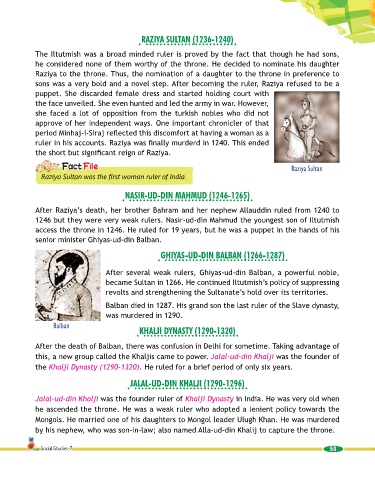
                                                                                                      Raziya Sultan
               Raziya Sultan was the first woman ruler of India.


                                            nasir-ud-din mahmud (1246-1265)

             After Raziya’s death, her brother Bahram and her nephew Allauddin ruled from 1240 to
             1246 but they were very weak rulers. Nasir-ud-din Mahmud the youngest son of Iltutmish

             access the throne in 1246. He ruled for 19 years, but he was a puppet in the hands of his
             senior minister Ghiyas-ud-din Balban.

                                                         ghiyas-ud-din balban (1266-1287)


                                      After several weak rulers, Ghiyas-ud-din Balban, a powerful noble,
                                      became Sultan in 1266. He continued Iltutmish’s policy of suppressing
                                      revolts and strengthening the Sultanate’s hold over its territories.

                                      Balban died in 1287. His grand son the last ruler of the Slave dynasty,
                                      was murdered in 1290.
                   Balban
                                                 Khalji dynasTy (1290-1320)


             After the death of Balban, there was confusion in Delhi for sometime. Taking advantage of
             this, a new group called the Khaljis came to power. Jalal-ud-din Khalji was the founder of
             the Khalji Dynasty (1290-1320). He ruled for a brief period of only six years.

                                              jalal-ud-din Khalji (1290-1296)


             Jalal-ud-din Khalji was the founder ruler of Khalji Dynasty in India. He was very old when
             he ascended the throne. He was a weak ruler who adopted a lenient policy towards the

             Mongols. He married one of his daughters to Mongol leader Ulugh Khan. He was murdered
             by his nephew, who was son-in-law; also named Alla-ud-din Khalij to capture the throne.


               Social Studies-7                                                                                    59

