


Page 98 - sst_class_07
P. 98
by  the  governments.  That  is,  the  woman,  the  poor and  uneducated  persons were  not

             allowed to vote.
             In India, the voting age is 18 years. That is, all citizens of India who have attained the age
             of 18 years or above, can vote whether they are men or women, rich or poor, educated or
             uneducated.


             4. DEcision-making mEchanisms
                                              People  participate  in  the  decision-making  process in  a

                                              democracy.  But,  they  do not  participate  directly.  Instead,
                                              they choose their representatives through an election process.
                                              These representatives take decisions on behalf of the entire
                                              population.  While  making  decisions,  they  certainly  keep
                                              in mind the voices and interests of the people. The regular
                                              elections restrict the power of the government and increases
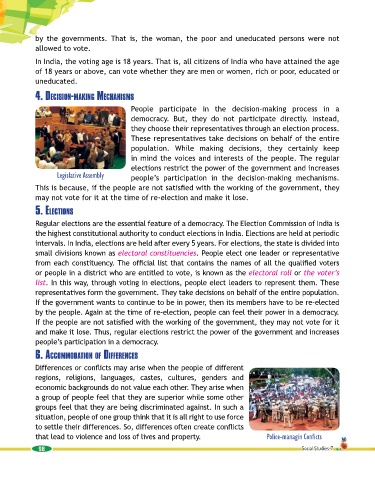
                     Legislative Assembly     people’s participation  in  the  decision-making  mechanisms.

             This is because, if the people are not satisfied with the working of the government, they
             may not vote for it at the time of re-election and make it lose.

             5. ElEctions
             Regular elections are the essential feature of a democracy. The Election Commission of India is
             the highest constitutional authority to conduct elections in India. Elections are held at periodic

             intervals. In India, elections are held after every 5 years. For elections, the state is divided into
             small divisions known as electoral constituencies. People elect one leader or representative
             from each constituency. The official list that contains the names of all the qualified voters
             or people in a district who are entitled to vote, is known as the electoral roll or the voter’s
             list. In this way, through voting in elections, people elect leaders to represent them. These
             representatives form the government. They take decisions on behalf of the entire population.
             If the government wants to continue to be in power, then its members have to be re-elected
             by the people. Again at the time of re-election, people can feel their power in a democracy.
             If the people are not satisfied with the working of the government, they may not vote for it

             and make it lose. Thus, regular elections restrict the power of the government and increases
             people’s participation in a democracy.

             6. accommoDation oF DiFFErEncEs
             Differences or conflicts may arise when the people of different
             regions, religions, languages, castes, cultures, genders and
             economic backgrounds do not value each other. They arise when

             a group of people feel that they are superior while some other
             groups feel that they are being discriminated against. In such a
             situation, people of one group think that it is all right to use force
             to settle their differences. So, differences often create conflicts
             that lead to violence and loss of lives and property.                           Police-managin Conficts

                                                                                                         Social Studies-7-7
              98
              98                                                                                         Social Studies

