


Page 99 - sst_class_07
P. 99
But, these differences may be accommodated by developing a tolerate attitude. Democracy

             provides a  peaceful  solution  to this  problem because  it  gives equal  opportunity  to all
             individuals before the law of the land. It shows a way to deal with differences and conflicts.
             Moreover, in a democracy, decisions are taken by the majority party or parties. The other
             parties  together  form  the  opposition. But, it  does not  mean  that  only the  will of  the

             majority will be taken into consideration. A democratic government tries to accommodate
             minority opinion also in order to enjoy the support of the people.

                                                       poliTical parTies

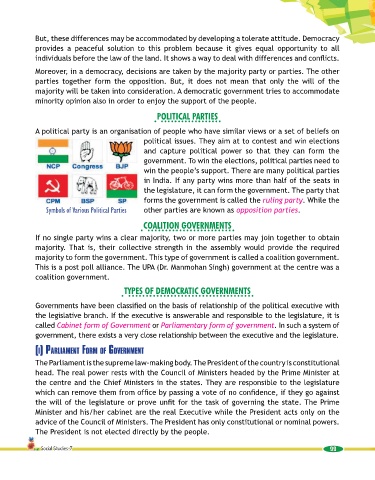
             A political party is an organisation of people who have similar views or a set of beliefs on
                                                   political issues. They aim at to contest and win elections

                                                   and  capture  political  power so  that  they  can  form  the
                                                   government. To win the elections, political parties need to
                                                   win the people’s support. There are many political parties
                                                   in India. If any party wins more than half of the seats in
                                                   the legislature, it can form the government. The party that
                                                   forms the government is called the ruling party. While the
                 Symbols of Various Political Parties  other parties are known as opposition parties.

                                                   coaliTion GovernmenTs

             If no single party wins a clear majority, two or more parties may join together to obtain
             majority. That is, their collective strength in the assembly would provide the required
             majority to form the government. This type of government is called a coalition government.

             This is a post poll alliance. The UPA (Dr. Manmohan Singh) government at the centre was a
             coalition government.

                                            Types of DemocraTic GovernmenTs

             Governments have been classified on the basis of relationship of the political executive with
             the legislative branch. If the executive is answerable and responsible to the legislature, it is
             called Cabinet form of Government or Parliamentary form of government. In such a system of
             government, there exists a very close relationship between the executive and the legislature.


             (i) ParliamEnt Form oF govErnmEnt
             The Parliament is the supreme law-making body. The President of the country is constitutional
             head. The real power rests with the Council of Ministers headed by the Prime Minister at

             the centre and the Chief Ministers in the states. They are responsible to the legislature
             which can remove them from office by passing a vote of no confidence, if they go against
             the will of the legislature or prove unfit for the task of governing the state. The Prime
             Minister and his/her cabinet are the real Executive while the President acts only on the
             advice of the Council of Ministers. The President has only constitutional or nominal powers.
             The President is not elected directly by the people.


               Social Studies-7                                                                                    99

