


Page 93 - sst_class_07
P. 93
flouRishinG danCe foRms
             India has a glorious dance tradition since time immortal. During the medieval period, each
             specific region of India started developing its own particular dance form.

             Indian dance also has a rich tradition. It has been a medium of expression of emotions

             since the ancient times. The popular image of Shiva in the form of Nataraja symbolises the
             influence of this art forms on the life of the Indian people. There are six forms of Indian
             classical dance.
                                              These are as under :

                                                (i)   Kathak (North India)
                                                (ii)  Bharatanatyam (Tamil Nadu)

                                                (iii) Kathakali (Kerala)
                                                (iv)  Odissi (Orissa)
                                                (v)  Kuchipudi (Andra Pradesh)

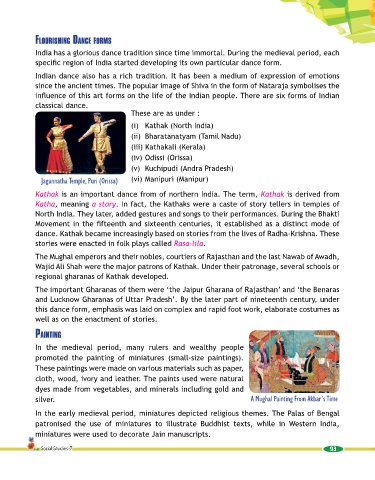
               Jagannatha Temple, Puri (Orissa)    (vi)  Manipuri (Manipur)

             Kathak is an important dance from of northern India. The term, Kathak is derived from
             Katha, meaning a story. In fact, the Kathaks were a caste of story tellers in temples of
             North India. They later, added gestures and songs to their performances. During the Bhakti
             Movement in the fifteenth and sixteenth centuries, it established as a distinct mode of
             dance. Kathak became increasingly based on stories from the lives of Radha-Krishna. These

             stories were enacted in folk plays called Rasa-lila.
             The Mughal emperors and their nobles, courtiers of Rajasthan and the last Nawab of Awadh,
             Wajid Ali Shah were the major patrons of Kathak. Under their patronage, several schools or

             regional gharanas of Kathak developed.

             The important Gharanas of them were ‘the Jaipur Gharana of Rajasthan’ and ‘the Benaras
             and Lucknow Gharanas of Uttar Pradesh’. By the later part of nineteenth century, under
             this dance form, emphasis was laid on complex and rapid foot work, elaborate costumes as
             well as on the enactment of stories.

             PaintinG

             In  the medieval period, many  rulers and wealthy  people
             promoted the  painting of miniatures  (small-size  paintings).
             These paintings were made on various materials such as paper,

             cloth, wood, ivory and leather. The paints used were natural
             dyes made from vegetables, and minerals including gold and
             silver.                                                                    A Mughal Painting From Akbar’s Time

             In the early medieval period, miniatures depicted religious themes. The Palas of Bengal
             patronised  the  use  of miniatures  to illustrate  Buddhist  texts,  while  in Western  India,

             miniatures were used to decorate Jain manuscripts.

               Social Studies-7                                                                                    93

