


Page 87 - sst_class_07
P. 87
of Bundelkhand (northern Madhya Pradesh) under their direct control. They angered the
             Jats, the Rohilla Afghans of Rohilkhand (east of the Jat kingdom) and the Nawab of Awadh
             by raiding their territories and forcing them to pay tribute. In 1751, the Marathas forced
             the Nawab of Bengal to cede Orissa and pay tribute.
             The  expansion  of Maratha  rule  initially  harmed  some local crafts.  For  example,  many
             silk weavers of Gujarat fled to Varanasi. However, by the mid-eighteenth century, there
             seem to have been some economic recovery under the Marathas. Trade was encouraged,
             which helped banking, crafts and agriculture. Among the industries which flourished in the
             western Deccan were brassworking in Kalyan, the paper industry and mixed silk and cotton
             brocaded cloth industries of Aurangabad, the textile industries of Chanderi and Burhanpur,
             and the coarse cotton cloth, basket-making and perfume industries of Pune.
             Under  the  peshwas,  who were  high-ranking Brahmans  called  Chitpavan  Brahmans,  the
             employment  opportunities  for  Brahmans  increased.  They  were  employed  as scribes,
             administrators, bankers and even soldiers.
             Third battle of Panipat : In 1757, the Marathas helped the
             Mughal Emperor by removing the agent posted in Delhi
             by Ahmad Shah Abdali. Thereafter, they took Sirhind and
             Lahore from the Afghans. All this made a war between the
             Marathas and the Afghans inevitable. The Maratha army
             met Abdali’s forces in the third battle of Panipat in 1761.
             Ahmad Shah Abdali had entered into alliance with the
             enemies of the Marathas, mainly the rulers of Rohilkhand
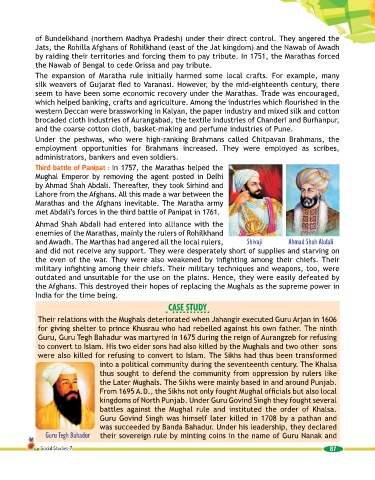
             and Awadh. The Marthas had angered all the local rulers,                 Shivaji        Ahmad Shah Abdali
             and did not receive any support. They were desperately short of supplies and starving on
             the even of the war. They were also weakened by infighting among their chiefs. Their
             military infighting among their chiefs. Their military techniques and weapons, too, were
             outdated and unsuitable for the use on the plains. Hence, they were easily defeated by
             the Afghans. This destroyed their hopes of replacing the Mughals as the supreme power in
             India for the time being.
                                                           case sTudy

              Their relations with the Mughals deteriorated when Jahangir executed Guru Arjan in 1606
              for giving shelter to prince Khusrau who had rebelled against his own father. The ninth
              Guru, Guru Tegh Bahadur was martyred in 1675 during the reign of Aurangzeb for refusing
              to convert to Islam. His two elder sons had also killed by the Mughals and two other  sons
              were also killed for refusing to convert to Islam. The Sikhs had thus been transformed
                                    into a political community during the seventeenth century. The Khalsa
                                    thus sought to defend the community from oppression by rulers like
                                    the Later Mughals. The Sikhs were mainly based in and around Punjab.
                                    From 1695 A.D., the Sikhs not only fought Mughal officials but also local
                                    kingdoms of North Punjab. Under Guru Govind Singh they fought several
                                    battles  against  the  Mughal  rule and  instituted  the  order  of  Khalsa.
                                    Guru Govind Singh was himself later killed in 1708 by a pathan and
                                    was succeeded by Banda Bahadur. Under his leadership, they declared
                 Guru Tegh Bahadur  their sovereign rule by minting coins in the name of Guru Nanak and

               Social Studies-7                                                                                    87

