


Page 69 - sst_class_07
P. 69
Chapter  12           Tribal and nomadiC

                                        CommUniTies


             A  tribe  can  be  defined  as  a  community  living  in  hilly  forest  or  well  demarcated  areas
             having its own culture, religion, language and strong ethnic identity. Anthropologists have
             explained tribes as a social group with territorial affiliation, endogamous in nature, with
             no specialisation of functions, ruled by tribal chiefs, hereditary or otherwise, united in
             language or dialect, recognising social distance with other tribes or castes, following tribal
             traditions and beliefs and customs.

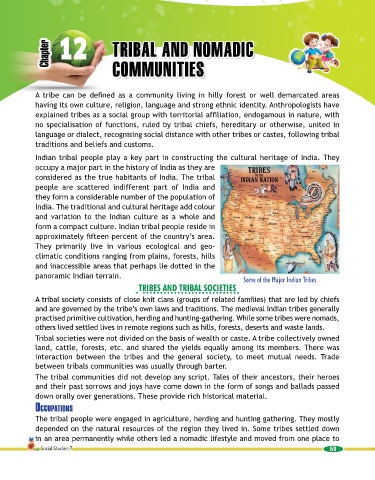
             Indian tribal people play a key part in constructing the cultural heritage of India. They
             occupy a major part in the history of India as they are
             considered as the true habitants of India. The tribal
             people  are  scattered  indifferent  part  of India  and

             they form a considerable number of the population of
             India. The traditional and cultural heritage add colour
             and  variation  to  the  Indian  culture  as  a  whole  and
             form a compact culture. Indian tribal people reside in
             approximately fifteen percent of the country’s area.
             They primarily live in various ecological and  geo-
             climatic conditions ranging from plains, forests, hills
             and inaccessible areas that perhaps lie dotted in the
             panoramic Indian terrain.                                               Some of the Major Indian Tribes

                                                 Tribes and Tribal sOcieTies

             A tribal society consists of close knit clans (groups of related families) that are led by chiefs
             and are governed by the tribe’s own laws and traditions. The medieval Indian tribes generally
             practised primitive cultivation, herding and hunting-gathering. While some tribes were nomads,
             others lived settled lives in remote regions such as hills, forests, deserts and waste lands.
             Tribal societies were not divided on the basis of wealth or caste. A tribe collectively owned
             land, cattle, forests, etc. and shared the yields equally among its members. There was
             interaction  between  the  tribes  and  the  general  society, to meet  mutual  needs.  Trade
             between tribals communities was usually through barter.
             The tribal communities did not develop any script. Tales of their ancestors, their heroes
             and their past sorrows and joys have come down in the form of songs and ballads passed
             down orally over generations. These provide rich historical material.

             oCCuPations
             The tribal people were engaged in agriculture, herding and hunting gathering. They mostly

             depended on the natural resources of the region they lived in. Some tribes settled down
             in an area permanently while others led a nomadic lifestyle and moved from one place to
               Social Studies-7                                                                                    69

