


Page 24 - sst_class_07
P. 24
movEmENts of ocEaN WatEr
             The ocean water moves constantly. Both the
             temperature and salinity are responsible for

             its constant motion. Waves, tides and ocean
             currents are the different kinds of movements
             of ocean water.

             1. WavEs

             The surface of the earth’s oceans is in constant motion, moving up and down in the form
             of waves. If you have been to a beach, you have witnessed waves first hand.
                                                            Waves form as energy is transferred from molecule
                                                            to molecule across the surface. In general, the water
                                                            molecules move very little. It is only the energy that
                                                            actually moves. However, as waves break across a
                                                            shore or crash in violent storms, they can be the
                                                            source for great mixing of an ocean’s water.

                                                            Everything from earthquakes to ship wrecks create
                                                            waves; however, the most common cause is wind.
                                                            As wind passes over the water’s surface, friction
                                                            forces it to ripple. The rise and fall of water takes
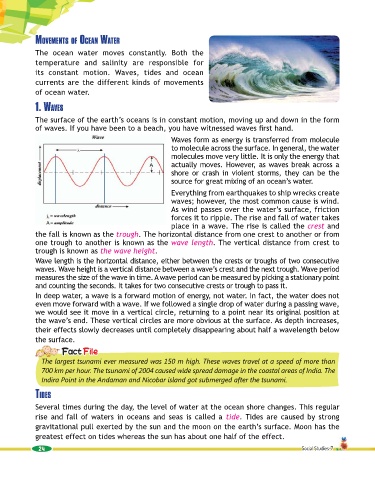
                                                            place in a wave. The rise is called the crest and
             the fall is known as the trough. The horizontal distance from one crest to another or from
             one trough to another is known as the wave length. The vertical distance from crest to
             trough is known as the wave height.
             Wave length is the horizontal distance, either between the crests or troughs of two consecutive
             waves. Wave height is a vertical distance between a wave’s crest and the next trough. Wave period
             measures the size of the wave in time. A wave period can be measured by picking a stationary point
             and counting the seconds. It takes for two consecutive crests or trough to pass it.
             In deep water, a wave is a forward motion of energy, not water. In fact, the water does not
             even move forward with a wave. If we followed a single drop of water during a passing wave,
             we would see it move in a vertical circle, returning to a point near its original position at
             the wave’s end. These vertical circles are more obvious at the surface. As depth increases,
             their effects slowly decreases until completely disappearing about half a wavelength below
             the surface.


               The largest tsunami ever measured was 150 m high. These waves travel at a speed of more than
               700 km per hour. The tsunami of 2004 caused wide spread damage in the coastal areas of India. The
               Indira Point in the Andaman and Nicobar island got submerged after the tsunami.

             tidEs

             Several times during the day, the level of water at the ocean shore changes. This regular
             rise and fall of waters in oceans and seas is called a tide. Tides are caused by strong
             gravitational pull exerted by the sun and the moon on the earth’s surface. Moon has the
             greatest effect on tides whereas the sun has about one half of the effect.

                                                                                                         Social Studies
              24
              24                                                                                         Social Studies-7-7

