


Page 19 - sst_class_07
P. 19
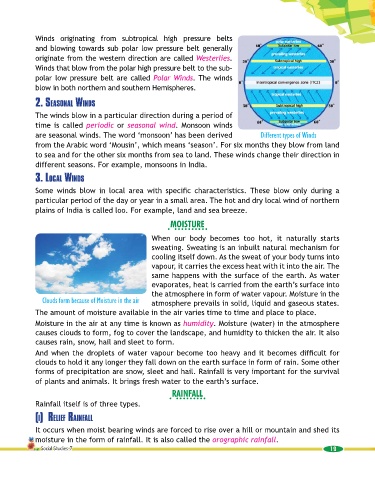
Winds originating from subtropical high pressure belts

             and blowing towards sub polar low pressure belt generally
             originate from the western direction are called Westerlies.
             Winds that blow from the polar high pressure belt to the sub-
             polar low pressure belt are called Polar Winds. The winds
             blow in both northern and southern Hemispheres.

             2. sEasoNal WiNds

             The winds blow in a particular direction during a period of
             time is called periodic or seasonal wind. Monsoon winds
             are seasonal winds. The word ‘monsoon’ has been derived                       Different types of Winds
             from the Arabic word ‘Mousin’, which means ‘season’. For six months they blow from land
             to sea and for the other six months from sea to land. These winds change their direction in
             different seasons. For example, monsoons in India.


             3. local WiNds
             Some  winds  blow  in  local  area  with  specific  characteristics.  These  blow  only  during  a
             particular period of the day or year in a small area. The hot and dry local wind of northern
             plains of India is called loo. For example, land and sea breeze.

                                                            moisturE

                                                     When  our body becomes too hot,  it  naturally  starts
                                                     sweating. Sweating is an inbuilt natural mechanism for
                                                     cooling itself down. As the sweat of your body turns into
                                                     vapour, it carries the excess heat with it into the air. The
                                                     same happens with the surface of the earth. As water
                                                     evaporates, heat is carried from the earth’s surface into
                                                     the atmosphere in form of water vapour. Moisture in the
                Clouds form because of Moisture in the air  atmosphere prevails in solid, liquid and gaseous states.
             The amount of moisture available in the air varies time to time and place to place.

             Moisture in the air at any time is known as humidity. Moisture (water) in the atmosphere
             causes clouds to form, fog to cover the landscape, and humidity to thicken the air. It also
             causes rain, snow, hail and sleet to form.
             And when the droplets of water vapour become too heavy and it becomes difficult for
             clouds to hold it any longer they fall down on the earth surface in form of rain. Some other
             forms of precipitation are snow, sleet and hail. Rainfall is very important for the survival
             of plants and animals. It brings fresh water to the earth’s surface.

                                                             rainfall
             Rainfall itself is of three types.

             (i)  rEliEf raiNfall

             It occurs when moist bearing winds are forced to rise over a hill or mountain and shed its
             moisture in the form of rainfall. It is also called the orographic rainfall.
               Social Studies-7                                                                                    19

