


Page 22 - sst_class_07
P. 22
Chapter  4             WAtEr


             The earth appears blue from the outer space because of its immense water bodies. Water
             covers about 71% of the earth’s surface.

             We need  water  for  almost all the  activities  like—drinking,  cooking, washing  clothes  or
             utensils and many more. We also need water to generate electricity and for transportation
             too. Water is a major source of our livelihood.
             The following table shows the distribution of water on the earth surface.

              S.No.           Water bodies               Volume of water (in %)             Nature of Water

                1.    Oceans                                     97.3                            Saline Water
                2.    Ice Caps                                   02.0                            Fresh Water
                3.    Ground water                               0.68                            Fresh Water
                4.    Fresh  lakes and inland seas               0.009                           Fresh Water

                5.    Salt lakes                                 0.009                           Saline Water
                6.    Atmosphere                                 0.0019                          Fresh Water
                7.    Rivers                                     0.0001                          Fresh Water

                                                    tWo sourCEs of WatEr


             1. surfacE WatEr
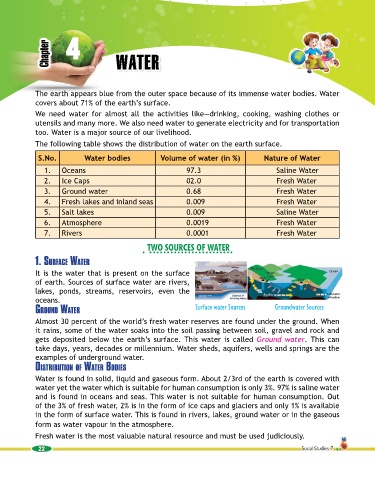
             It is the water that is present on the surface
             of earth. Sources of surface water are rivers,
             lakes, ponds, streams, reservoirs, even the
             oceans.
             grouNd WatEr                                            Surface water Sources      Groundwater Sources
             Almost 30 percent of the world’s fresh water reserves are found under the ground. When
             it rains, some of the water soaks into the soil passing between soil, gravel and rock and
             gets deposited below the earth’s surface. This water is called Ground water. This can
             take days, years, decades or millennium. Water sheds, aquifers, wells and springs are the
             examples of underground water.
             distriButioN of WatEr BodiEs

             Water is found in solid, liquid and gaseous form. About 2/3rd of the earth is covered with
             water yet the water which is suitable for human consumption is only 3%. 97% is saline water
             and is found in oceans and seas. This water is not suitable for human consumption. Out
             of the 3% of fresh water, 2% is in the form of ice caps and glaciers and only 1% is available
             in the form of surface water. This is found in rivers, lakes, ground water or in the gaseous
             form as water vapour in the atmosphere.

             Fresh water is the most valuable natural resource and must be used judiciously.

              22                                                                                         Social Studies-7

