


Page 25 - sst_class_07
P. 25
high tidEs aNd loW tidEs
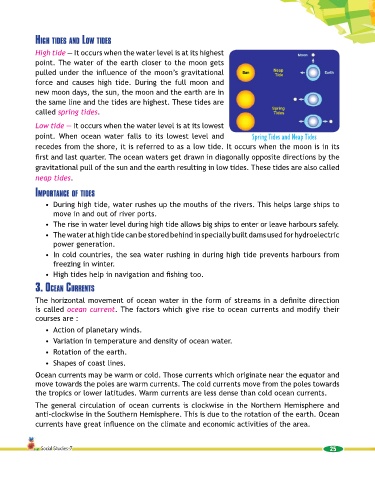
             High tide — It occurs when the water level is at its highest
             point. The water of the earth closer to the moon gets

             pulled under the influence of the moon’s gravitational
             force  and  causes  high tide.  During  the  full moon and
             new moon days, the sun, the moon and the earth are in
             the same line and the tides are highest. These tides are
             called spring tides.

             Low tide — It occurs when the water level is at its lowest
             point. When ocean water falls to its lowest level and                      Spring Tides and Neap Tides

             recedes from the shore, it is referred to as a low tide. It occurs when the moon is in its
             first and last quarter. The ocean waters get drawn in diagonally opposite directions by the
             gravitational pull of the sun and the earth resulting in low tides. These tides are also called
             neap tides.


             importaNcE of tidEs
                 •  During high tide, water rushes up the mouths of the rivers. This helps large ships to
                   move in and out of river ports.
                 •  The rise in water level during high tide allows big ships to enter or leave harbours safely.

                 •  The water at high tide can be stored behind in specially built dams used for hydroelectric
                   power generation.
                 •  In cold countries, the sea water rushing in during high tide prevents harbours from
                   freezing in winter.
                 •  High tides help in navigation and fishing too.

             3. ocEaN currENts

             The horizontal movement of ocean water in the form of streams in a definite direction
             is called ocean current. The factors which give rise to ocean currents and modify their
             courses are :
                 •  Action of planetary winds.
                 •  Variation in temperature and density of ocean water.

                 •  Rotation of the earth.
                 •  Shapes of coast lines.

             Ocean currents may be warm or cold. Those currents which originate near the equator and
             move towards the poles are warm currents. The cold currents move from the poles towards
             the tropics or lower latitudes. Warm currents are less dense than cold ocean currents.
             The general circulation of ocean currents is clockwise in the Northern Hemisphere and
             anti-clockwise in the Southern Hemisphere. This is due to the rotation of the earth. Ocean
             currents have great influence on the climate and economic activities of the area.


               Social Studies-7                                                                                    25

