


Page 29 - sst_class_07
P. 29
(i) EarthquakEs
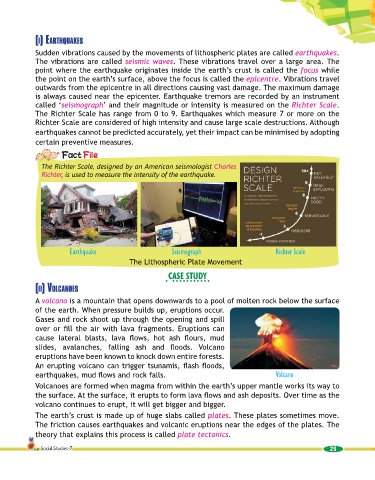
             Sudden vibrations caused by the movements of lithospheric plates are called earthquakes.
             The vibrations are called seismic waves. These vibrations travel over a large area. The
             point where the earthquake originates inside the earth’s crust is called the focus while
             the point on the earth’s surface, above the focus is called the epicentre. Vibrations travel
             outwards from the epicentre in all directions causing vast damage. The maximum damage
             is always caused near the epicenter. Earthquake tremors are recorded by an instrument
             called ‘seismograph’ and their magnitude or intensity is measured on the Richter Scale.
             The Richter Scale has range from 0 to 9. Earthquakes which measure 7 or more on the
             Richter Scale are considered of high intensity and cause large scale destructions. Although

             earthquakes cannot be predicted accurately, yet their impact can be minimised by adopting
             certain preventive measures.


               The Richter Scale, designed by an American seismologist Charles
               Richter, is used to measure the intensity of the earthquake.


                         Earthquake                         Seismograph                         Richter Scale

                                              The Lithospheric Plate Movement
                                                           CasE study

             (ii) volcaNoEs

             A volcano is a mountain that opens downwards to a pool of molten rock below the surface
             of the earth. When pressure builds up, eruptions occur.
             Gases and rock shoot up through the opening and spill
             over or fill the air with lava fragments. Eruptions can
             cause  lateral  blasts,  lava  flows,  hot  ash  flours,  mud
             slides,  avalanches,  falling  ash  and  floods.  Volcano
             eruptions have been known to knock down entire forests.
             An erupting volcano can trigger tsunamis, flash floods,
             earthquakes, mud flows and rock falls.                                             Volcano
             Volcanoes are formed when magma from within the earth’s upper mantle works its way to
             the surface. At the surface, it erupts to form lava flows and ash deposits. Over time as the
             volcano continues to erupt, it will get bigger and bigger.

             The earth’s crust is made up of huge slabs called plates. These plates sometimes move.
             The friction causes earthquakes and volcanic eruptions near the edges of the plates. The
             theory that explains this process is called plate tectonics.

               Social Studies-7                                                                                    29

