


Page 23 - sst_class_07
P. 23
Our Earth is called the ‘watery planet'. 71% of the earth’s surface is covered with water while only
               29% is the land area. The water is found in oceans, seas, lakes, rivers, etc. The domains of water is
               called the hydrosphere.


             WatEr cyclE

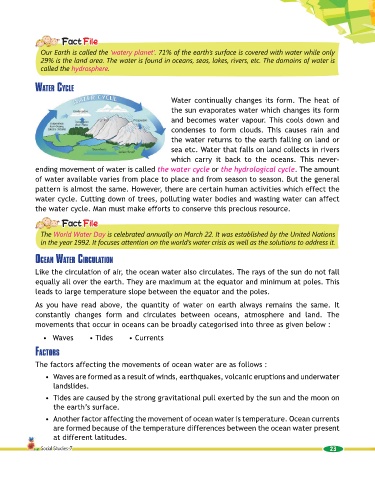
                                                            Water continually changes its form. The heat of
                                                            the sun evaporates water which changes its form
                                                            and becomes water vapour. This cools down and
                                                            condenses  to  form  clouds.  This causes  rain  and
                                                            the water returns to the earth falling on land or
                                                            sea etc. Water that falls on land collects in rivers
                                                            which  carry it back  to  the  oceans.  This never-

             ending movement of water is called the water cycle or the hydrological cycle. The amount
             of water available varies from place to place and from season to season. But the general
             pattern is almost the same. However, there are certain human activities which effect the
             water cycle. Cutting down of trees, polluting water bodies and wasting water can affect
             the water cycle. Man must make efforts to conserve this precious resource.


               The World Water Day is celebrated annually on March 22. It was established by the United Nations
               in the year 1992. It focuses attention on the world’s water crisis as well as the solutions to address it.


             ocEaN WatEr circulatioN

             Like the circulation of air, the ocean water also circulates. The rays of the sun do not fall
             equally all over the earth. They are maximum at the equator and minimum at poles. This
             leads to large temperature slope between the equator and the poles.

             As  you have  read above, the  quantity  of  water  on earth  always  remains  the  same.  It
             constantly  changes  form and  circulates  between  oceans,  atmosphere  and  land.  The
             movements that occur in oceans can be broadly categorised into three as given below :

               •  Waves       • Tides       • Currents

             factors

             The factors affecting the movements of ocean water are as follows :
                 •  Waves are formed as a result of winds, earthquakes, volcanic eruptions and underwater
                   landslides.

                 •  Tides are caused by the strong gravitational pull exerted by the sun and the moon on
                   the earth’s surface.
                 •  Another factor affecting the movement of ocean water is temperature. Ocean currents
                   are formed because of the temperature differences between the ocean water present
                   at different latitudes.

               Social Studies-7                                                                                    23

