


Page 18 - sst_class_07
P. 18
equator and decreases pole wards. The amount of insolation received differs from season

             to season and also between day and night. The earth has been broadly divided into three
             heat zones depending upon the amount of insolation received. The temperature of any
             place also depends upon its height above sea level and its distance from the sea. Places
             located near the sea will experience moderate temperature, but those away from the sea,
             will generally experience extreme temperature.

                                    Of  course,  the  temperature  recordings  are  never  solely  dependent  on
                                    any one factor. Various factors affect the climate of a place. Winds,
                                    ocean current, slope of land, vegetation cover are the many factors that
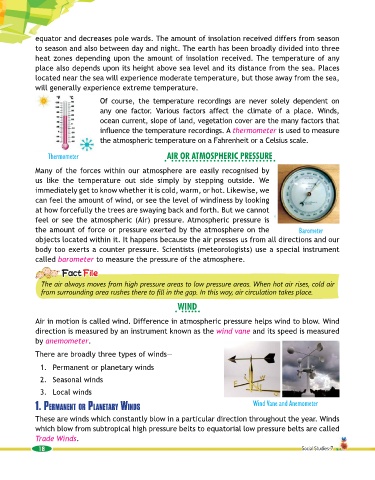
                                    influence the temperature recordings. A thermometer is used to measure
                                    the atmospheric temperature on a Fahrenheit or a Celsius scale.


                  Thermometer                              air or atmosphEriC prEssurE

             Many of the forces within our atmosphere are easily recognised by
             us  like  the temperature  out  side  simply  by  stepping  outside.  We
             immediately get to know whether it is cold, warm, or hot. Likewise, we
             can feel the amount of wind, or see the level of windiness by looking
             at how forcefully the trees are swaying back and forth. But we cannot
             feel or see the atmospheric (Air) pressure. Atmospheric pressure is
             the amount of force or pressure exerted by the atmosphere on the                           Barometer

             objects located within it. It happens because the air presses us from all directions and our
             body too exerts a counter pressure. Scientists (meteorologists) use a special instrument
             called barometer to measure the pressure of the atmosphere.


               The air always moves from high pressure areas to low pressure areas. When hot air rises, cold air
               from surrounding area rushes there to fill in the gap. In this way, air circulation takes place.

                                                              Wind

             Air in motion is called wind. Difference in atmospheric pressure helps wind to blow. Wind
             direction is measured by an instrument known as the wind vane and its speed is measured
             by anemometer.

             There are broadly three types of winds—

               1.  Permanent or planetary winds

               2.  Seasonal winds

               3.  Local winds
                                                                                        Wind Vane and Anemometer
             1. pErmaNENt or plaNEtary WiNds
             These are winds which constantly blow in a particular direction throughout the year. Winds

             which blow from subtropical high pressure belts to equatorial low pressure belts are called
             Trade Winds.
                                                                                                         Social Studies-7-7
              18
              18                                                                                         Social Studies

