


Page 127 - sst_class_07
P. 127
4. avoiDing vulgarity
The media should not publish or broadcast those images or expressions that are rude or
obscene.
5. corrEcting Errors
If an error is found in any news given by the media, they should promptly publish or
broadcast the correct version of the news. They should also apologise for the mistake.
thE PoPular strugglE (right to inFormation act, 2005)
A public movement began in the state of Rajasthan in the
1990s that demanded the right to information. In fact,
the people who were employed in public works, were
being denied their full wages. When they wanted to see
the records to claim their full wages, the government
officials denied to show them on the ground that such
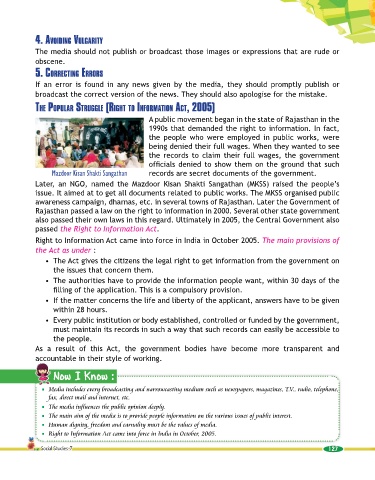
Mazdoor Kisan Shakti Sangathan records are secret documents of the government.
Later, an NGO, named the Mazdoor Kisan Shakti Sangathan (MKSS) raised the people’s
issue. It aimed at to get all documents related to public works. The MKSS organised public
awareness campaign, dharnas, etc. in several towns of Rajasthan. Later the Government of
Rajasthan passed a law on the right to information in 2000. Several other state government
also passed their own laws in this regard. Ultimately in 2005, the Central Government also
passed the Right to Information Act.
Right to Information Act came into force in India in October 2005. The main provisions of
the Act as under :
• The Act gives the citizens the legal right to get information from the government on
the issues that concern them.
• The authorities have to provide the information people want, within 30 days of the
filling of the application. This is a compulsory provision.
• If the matter concerns the life and liberty of the applicant, answers have to be given
within 28 hours.
• Every public institution or body established, controlled or funded by the government,
must maintain its records in such a way that such records can easily be accessible to
the people.
As a result of this Act, the government bodies have become more transparent and
accountable in their style of working.
Now I Know :
Media includes every broadcasting and narrowcasting medium such as newspapers, magazines, T.V., radio, telephone,
fax, direct mail and internet, etc.
The media influences the public opinion deeply.
The main aim of the media is to provide people information on the various issues of public interest.
Human dignity, freedom and carnality must be the values of media.
Right to Information Act came into force in India in October, 2005.
Social Studies-7 127

