


Page 125 - sst_class_07
P. 125
chapter  21           UNDerSTaNDING meDIa


             Media is a plural form of the word medium, that means a way of communicating information,
             etc.  to  people. Media  includes  every broadcasting  and  narrowcasting  medium  such  as
             magazines, newspapers, T.V., radio, telephone, fax, direct mail and internet, etc.
                                                         Types of meDia


             On the basis of the technologies used by the media, they can
             be classified into print media and electronic media.

             1. Print mEDia

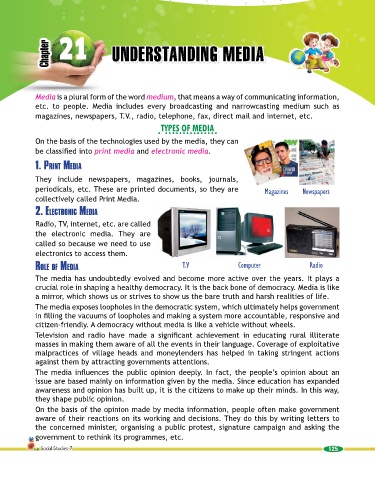
             They  include  newspapers,  magazines,  books,  journals,
             periodicals, etc. These are printed documents, so they are                     Magazines     Newspapers
             collectively called Print Media.

             2. ElEctronic mEDia
             Radio, TV, internet, etc. are called
             the  electronic  media.  They  are

             called so because we need to use
             electronics to access them.
             rolE oF mEDia                                      T.V                Computer                 Radio

             The media has undoubtedly evolved and become more active over the years. It plays a
             crucial role in shaping a healthy democracy. It is the back bone of democracy. Media is like
             a mirror, which shows us or strives to show us the bare truth and harsh realities of life.
             The media exposes loopholes in the democratic system, which ultimately helps government
             in filling the vacuums of loopholes and making a system more accountable, responsive and
             citizen-friendly. A democracy without media is like a vehicle without wheels.
             Television  and  radio  have  made  a  significant  achievement  in  educating  rural  illiterate
             masses in making them aware of all the events in their language. Coverage of exploitative
             malpractices  of village  heads  and  moneylenders  has  helped  in  taking  stringent  actions
             against them by attracting governments attentions.
             The media influences the public opinion deeply. In fact, the people’s opinion about an
             issue are based mainly on information given by the media. Since education has expanded
             awareness and opinion has built up, it is the citizens to make up their minds. In this way,
             they shape public opinion.
             On the basis of the opinion made by media information, people often make government
             aware of their reactions on its working and decisions. They do this by writing letters to
             the concerned minister, organising a public protest, signature campaign and asking the
             government to rethink its programmes, etc.

               Social Studies-7                                                                                   125

