


Page 71 - sst_class_06
P. 71
chapter  15           bUIldINgS, paINTINgS

                                        aNd bOOkS


                                                BuIldIngs In BrIck and stone

             The skills of our craftspersons prove that architecture had reached high degree of excellence
             during the Gupta period. the perfection which the art of sculpture attained during this
             period suggests that it had a long period of continues and steady development. The artistic
             remains of this period may be described as temples, stupas, pillars, palaces and caves.
             These buildings are made up of stones and bricks.

                                                      temples and stupas

             Some of the earliest Hindu temples were also built in
             the shrines to worship gods such as Vishnu, Shiva and
             Durga.  The most important Feature of the temple
             was the  garbhagriha, room where the image of the

             chief deity was placed and the priests would perform
             religious rituals and devotees offer worship to the deity.
             Most temples also had an open space (hall) known as
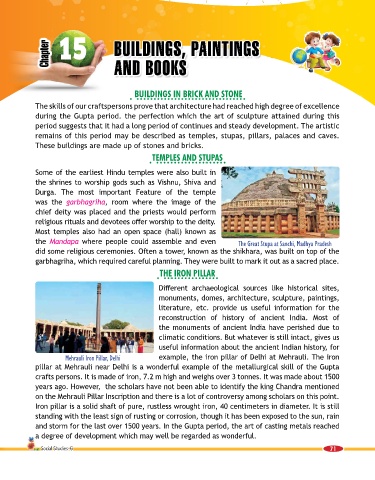
             the  Mandapa where people could assemble and even                     The Great Stupa at Sanchi, Madhya Pradesh
             did some religious ceremonies. Often a tower, known as the shikhara, was built on top of the
             garbhagriha, which required careful planning. They were built to mark it out as a sacred place.

                                                        tHe Iron pIllar

                                                        Different  archaeological  sources  like  historical  sites,
                                                        monuments, domes, architecture, sculpture, paintings,
                                                        literature, etc. provide us useful information for the
                                                        reconstruction of history of ancient India. Most of

                                                        the monuments of ancient India have perished due to
                                                        climatic conditions. But whatever is still intact, gives us
                                                        useful information about the ancient Indian history, for
                        Mehrauli Iron Pillar, Delhi     example, the iron pillar of Delhi at Mehrauli. The iron
             pillar at Mehrauli near Delhi is a wonderful example of the metallurgical skill of the Gupta
             crafts persons. It is made of iron, 7.2 m high and weighs over 3 tonnes. It was made about 1500
             years ago. However,  the scholars have not been able to identify the king Chandra mentioned
             on the Mehrauli Pillar Inscription and there is a lot of controversy among scholars on this point.
             Iron pillar is a solid shaft of pure, rustless wrought iron, 40 centimeters in diameter. It is still

             standing with the least sign of rusting or corrosion, though it has been exposed to the sun, rain
             and storm for the last over 1500 years. In the Gupta period, the art of casting metals reached
             a degree of development which may well be regarded as wonderful.

               Social Studies-6                                                                                    71

