


Page 67 - sst_class_06
P. 67
In many cities, archaeologists have found rows of pots or ceramic rings arranged one on top
             of the other. These are known as ring wells.

             The exploration of the cities and main towns/commercial centres were come through the
             sailor and explorers. One of the detailed accounts has been found written by an unknown
             Greek sailor. He described all the ports that he had visited.


                                                coIns


             Trade prospered in this period due to the introduction of coins.
             These coins were called punch-marked coins because the designs

             were punched on the coins made of silver or copper.
                                                                                                         Coins

                                                cItIes WItH many functIons

                                         The Greeks greatly  contributed  to the  development  of  Taxila,

                                         Gandhara and Mathura as the centres of art in India.
                                         They gave birth to Gandhara School of Art. It is partly Indian and

                                         partly Greek. Stone images and statues of the Buddha were carved.
                                         Mathura, which was the centre for indigenous school of art was
                                         also influenced by the invasions. A number of images of terracotta

                                         and red sandstone, which have definite Saka-Kushana influence,
                                         have survived. The Mathura school became first to make faces and
                                         figures of Buddha.

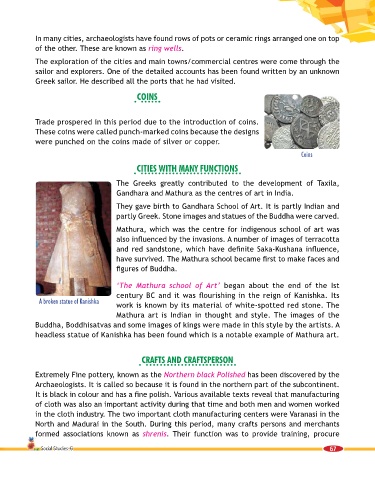
                                         ‘The Mathura school of  Art’ began about the end of the Ist

                                         century BC and it was flourishing in the reign of Kanishka. Its
               A broken statue of Kanishka
                                         work is known by its material of white-spotted red stone. The
                                         Mathura art is Indian in thought and style. The images of the
             Buddha, Boddhisatvas and some images of kings were made in this style by the artists. A
             headless statue of Kanishka has been found which is a notable example of Mathura art.


                                                  crafts and craftsperson


             Extremely Fine pottery, known as the Northern black Polished has been discovered by the
             Archaeologists. It is called so because it is found in the northern part of the subcontinent.
             It is black in colour and has a fine polish. Various available texts reveal that manufacturing
             of cloth was also an important activity during that time and both men and women worked
             in the cloth industry. The two important cloth manufacturing centers were Varanasi in the
             North and Madurai in the South. During this period, many crafts persons and merchants
             formed  associations known as  shrenis.  Their function  was to provide training,  procure


               Social Studies-6                                                                                    67

