


Page 66 - sst_class_06
P. 66
In tHe soutHern IndIa (tamIl regIon)


               1.  Ordinary ploughmen also known as Uzhavar.
               2.  Large landowners also known as Vellalar.

               3.  Landless labourers, including slaves, known as Kadaisiyar and Adimai.

                                           In tHe nortHern part of tHe country

             People used to follow the same profession for generations what their parents or grandparents
             had. In simple words, the post or profession was hereditary.

             The village headman or the largest landowner was known as the grama bhojaka. Generally, he
             had slaves and hired workers to cultivate the land. Besides, the king often used him to collect

             taxes from the village  as he was considered economically  powerful. He would sometimes
             perform the duties of a policeman and a judge also. The independent smaller landowners and
             farmers were known as grihapatis. People without land were called as dasa Karmakara and to
             earn their living, they had to work on others fields. Apart from these, in most villages, there
             were also some crafts persons such as the blacksmith, potter, carpenter and weaver. etc.


               Some of the earliest  works in Tamil,  Known as  Sangam literature, were composed around 2300
               years ago. These texts were called Sangam because they were supposed to have been composed and
               compiled in assemblies (known as sangams) of poets that were held in the city of Madurai.

                                                  fIndIng out aBout cItIes


             You may have heard of the Jatakas. The Jataka stories are extremely popular folktales.
             These were composed by ordinary people. The tales are based upon the events that took
             place during the many births of the Buddha. Each tale has a deep meaning and moral
             attached to Buddhist traditions.

             For the historians, the Jataka tales are an
             invaluable source as they throw light upon
             the every day thought and life of the people
             of  the  period. Many  valuable  information
             about the development of Indian sculpture,

             social and economic conditions of northern
             and southern India of that time are known
             from  the  Greek  accounts.  The Roman  and
             Greek traders, travellers came to the coastal
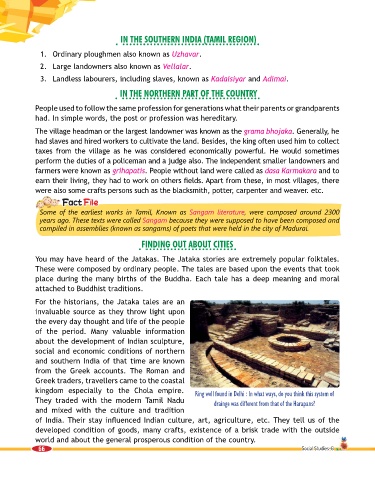
             kingdom  especially  to the  Chola  empire.            Ring well found in Delhi : In what ways, do you think this system of
             They traded with  the  modern  Tamil Nadu                     drainge was different from that of the Harapans?
             and  mixed  with  the  culture  and  tradition

             of India. Their stay influenced Indian culture, art, agriculture, etc. They tell us of the
             developed condition of goods, many crafts, existence of a brisk trade with the outside
             world and about the general prosperous condition of the country.
              66                                                                                         Social Studies-6

