


Page 62 - sst_class_06
P. 62
Chandragupta  II  defeated  the  Shakas  of Gujarat,  Saurashtra,  Malwa  and  annexed  their
             territories.  He  made  the  trading  town  of Ujjain  as his second  capital.  This further
             strengthened his control over trade.
             He promoted learning and art. He is said to have patronised nine renowned scholars, poets
             and artists, who were called the navaratna (nine gems). The poet Kalidasa is said to have
             been one of them.

             India After the Guptas : After the decline of the Gupta empire, some smaller kingdoms arose
             in North and South India. Among them, the prominent ones were the kingdom of Harsha in
             the North and that of the Chalukyas and Pallavas in South India.
                                               HarsHaVardHana (ad 606-647)

             In the AD 606, Harshavardhana became the ruler of Thanesvar in modern Haryana. He
             succeeded his brother Rajyavardhana, who had avenged the murder of his sister’s husband,
             the ruler of Kannauj, but had himself got killed. Harsha united the kingdoms of Thanesvar
             and Kannauj and made Kannauj as his capital.
             Kannauj  was relatively  safe from  foreign
             invasions as it was not very close to the North-
             West Frontier. The Gangetic Plain could also
             be better supervised from here.

             The Chinese pilgrim Hiven Tsang was a guest at
             Harsha’s court and stayed in the country for about
             15 years. Hiven Tsang wrote in detail on Harsha’s
             administration and court life. Information about
             Harsha’s reign is also available in Harsha’s
             biography Harshacharita written by Banabhatta.

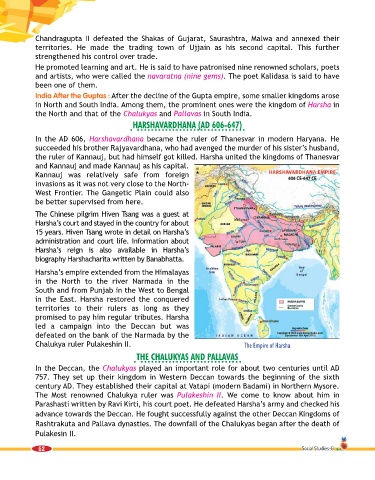
             Harsha’s empire extended from the Himalayas
             in  the  North  to  the  river Narmada  in  the
             South and from Punjab in the West to Bengal
             in  the  East.  Harsha  restored  the  conquered
             territories  to their  rulers as long as they
             promised to pay him regular tributes. Harsha
             led a campaign  into the  Deccan  but  was
             defeated on the bank of the Narmada by the
             Chalukya ruler Pulakeshin II.                                           The Empire of Harsha

                                                tHe cHalukyas and pallaVas
             In the Deccan, the Chalukyas played an important role for about two centuries until AD
             757. They set  up their  kingdom  in Western Deccan  towards the  beginning  of  the  sixth
             century AD. They established their capital at Vatapi (modern Badami) in Northern Mysore.
             The Most renowned  Chalukya  ruler was  Pulakeshin  II. We come to know  about  him  in
             Parashasti written by Ravi Kirti, his court poet. He defeated Harsha’s army and checked his
             advance towards the Deccan. He fought successfully against the other Deccan Kingdoms of
             Rashtrakuta and Pallava dynasties. The downfall of the Chalukyas began after the death of
             Pulakesin II.


              62                                                                                         Social Studies-6

