


Page 92 - sst_class_07
P. 92
rulers and religiOus TradiTiOns : The jagan-naTha culT


             At Puri, in Orissa, Anantavarman, one of the most important rulers of the Ganga dynasty,
                                              decided  to  erect  a  temple  for purushottama  Jagannatha  at
                                              Puri. The literal meaning of Jagannatha is ‘lord of the world,’
                                              a  name  for Vishnu.  Soon the  importance  of Jagannatha
                                              temple increased continuously as a centre of pilgrimage and
                                              its authority  in social and  political  matters  also increased

                                              simultaneously. The conquerors such as Mughals, Marathas and
                                              the English East India company tried to control the temple of
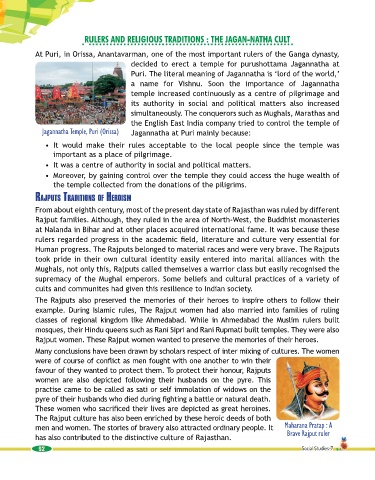
                Jagannatha Temple, Puri (Orissa)  Jagannatha at Puri mainly because:

                 •  It  would  make  their  rules  acceptable  to  the  local  people  since  the  temple  was
                   important as a place of pilgrimage.

                 •  It was a centre of authority in social and political matters.
                 •  Moreover, by gaining control over the temple they could access the huge wealth of
                   the temple collected from the donations of the piligrims.

             RajPuts tRaditions of heRoism
             From about eighth century, most of the present day state of Rajasthan was ruled by different
             Rajput families. Although, they ruled in the area of North-West, the Buddhist monasteries
             at Nalanda in Bihar and at other places acquired international fame. It was because these

             rulers regarded progress in the academic field, literature and culture very essential for
             Human progress. The Rajputs belonged to material races and were very brave. The Rajputs
             took pride in their own cultural identity  easily entered  into marital alliances  with the
             Mughals, not only this, Rajputs called themselves a warrior class but easily recognised the
             supremacy of the Mughal emperors. Some beliefs and cultural practices of a variety of
             cults and communites had given this resilience to Indian society.

             The Rajputs also preserved the memories of their heroes to inspire others to follow their
             example. During Islamic rules, The Rajput women had also married into families of ruling
             classes of regional kingdom like Ahmedabad. While in Ahmedabad the Muslim rulers built
             mosques, their Hindu queens such as Rani Sipri and Rani Rupmati built temples. They were also
             Rajput women. These Rajput women wanted to preserve the memories of their heroes.

             Many conclusions have been drawn by scholars respect of inter mixing of cultures. The women
             were of course of conflict as men fought with one another to win their
             favour of they wanted to protect them. To protect their honour, Rajputs
             women are also depicted following their husbands on the pyre.  This
             practise came to be called as sati or self immolation of widows on the
             pyre of their husbands who died during fighting a battle or natural death.
             These women who sacrificed their lives are depicted as great heroines.
             The Rajput culture has also been enriched by these heroic deeds of both
             men and women. The stories of bravery also attracted ordinary people. It              Maharana Pratap : A
             has also contributed to the distinctive culture of Rajasthan.                          Brave Rajput ruler

              92                                                                                         Social Studies-7

