


Page 72 - sst_class_07
P. 72
Costumes
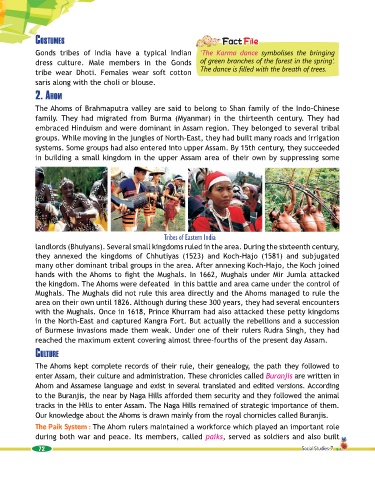
             Gonds  tribes of India have  a  typical  Indian  ‘The Karma dance symbolises the bringing
             dress culture.  Male  members  in  the  Gonds            of green branches of the forest in the spring’.

             tribe  wear Dhoti.  Females  wear soft  cotton           The dance is filled with the breath of trees.
             saris along with the choli or blouse.

             2. ahom
             The Ahoms of Brahmaputra valley are said to belong to Shan family of the Indo-Chinese
             family. They had  migrated  from  Burma  (Myanmar)  in  the  thirteenth  century. They  had

             embraced Hinduism and were dominant in Assam region. They belonged to several tribal
             groups. While moving in the jungles of North-East, they had built many roads and irrigation
             systems. Some groups had also entered into upper Assam. By 15th century, they succeeded
             in building a small kingdom in the upper Assam area of their own by suppressing some


                                                          Tribes of Eastern India
             landlords (Bhuiyans). Several small kingdoms ruled in the area. During the sixteenth century,
             they  annexed  the  kingdoms  of  Chhutiyas  (1523)  and  Koch-Hajo (1581)  and  subjugated
             many other dominant tribal groups in the area. After annexing Koch-Hajo, the Koch joined
             hands with the Ahoms to fight the Mughals. In 1662, Mughals under Mir Jumla attacked
             the kingdom. The Ahoms were defeated  in this battle and area came under the control of
             Mughals. The Mughals did not rule this area directly and the Ahoms managed to rule the
             area on their own until 1826. Although during these 300 years, they had several encounters
             with the Mughals. Once in 1618, Prince Khurram had also attacked these petty kingdoms
             in the North-East and captured Kangra Fort. But actually the rebellions and a succession
             of Burmese invasions made them weak. Under one of their rulers Rudra Singh, they had
             reached the maximum extent covering almost three-fourths of the present day Assam.

             CultuRe

             The Ahoms kept complete records of their rule, their genealogy, the path they followed to
             enter Assam, their culture and administration. These chronicles called Buranjis are written in
             Ahom and Assamese language and exist in several translated and edited versions. According
             to the Buranjis, the near by Naga Hills afforded them security and they followed the animal
             tracks in the Hills to enter Assam. The Naga Hills remained of strategic importance of them.

             Our knowledge about the Ahoms is drawn mainly from the royal chornicles called Buranjis.
             The Paik System : The Ahom rulers maintained a workforce which played an important role
             during both war and peace. Its members, called paiks, served as soldiers and also built

              72                                                                                         Social Studies-7

