


Page 57 - sst_class_06
P. 57
chapter  12            THe fIRST empIRe


                                         IN INdIa


             The Magadha Kingdom grew and became a big empire under the Mauryans in the 4th Century BC
             and it was the first empire of Indian sub-continent. Magadha not only established control over
             the other Mahajanpadas, but also drew tributes from remote regions beyond the Mahajanpadas.
             It thus became the centre of an empire whose military strength was acknowledged by all and
             nobody dared to challeng it. First of all Mauryans ruled over the whole of the Indian sub-continent.
             Moreover, all the power was in the hands of the emperor, who ruled from the capital Pataliputra.
                                                     tHe mauryan empIre

             When Alexander, the world famous Greek conqueror, attacked India in 326 BC, the Nanda
             rulers were ruling Magadha. Their rule had become unpopular, taking advantage of this, an
             ambitious youth named Chandra-gupta Maurya succeeded in overthrowing the Nandas and
             in founding the Mauryan dynasty. His guide and mentor was a Brahmana called Kautilya,
             also known as Chanakya—the author of Arthashastra. The first Mauryan ruler, Chandragupta
             established his capital at Pataliputra. He expanded his empire from North to South and
             East to West including Afghanistan and Baluchistan.

             The Mauryan Empire was the first empire in Indian history. The three most important rulers
             of this dynasty were Chandragupta Maurya, his son Bindusara and Bindusara’s son Ashoka.

             Bindusara : Chandragupta Maurya was succeeded by his son Bindusara. Bindusara ruled from
             297 to 273 BC. He was also a great conqueror and extended the empire from the Hindukush in
             the West to Bengal in the East and from the Himalayas in North to the present Karnataka in the
             South. At the time of his death, almost the entire sub-continent came under the Mauryan rule.

                                                     asHoka (269-232 Bc)
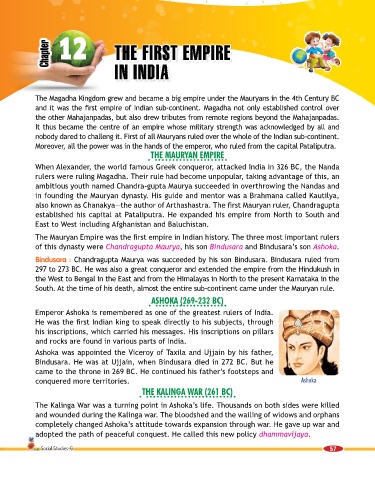
             Emperor Ashoka is remembered as one of the greatest rulers of India.
             He was the first Indian king to speak directly to his subjects, through
             his inscriptions, which carried his messages. His inscriptions on pillars
             and rocks are found in various parts of India.

             Ashoka was appointed the Viceroy of Taxila and Ujjain by his father,
             Bindusara. He was at Ujjain, when Bindusara died in 272 BC. But he
             came to the throne in 269 BC. He continued his father’s footsteps and
             conquered more territories.                                                                 Ashoka
                                                  tHe kalInga War (261 Bc)

             The Kalinga War was a turning point in Ashoka’s life. Thousands on both sides were killed
             and wounded during the Kalinga war. The bloodshed and the wailing of widows and orphans
             completely changed Ashoka’s attitude towards expansion through war. He gave up war and

             adopted the path of peaceful conquest. He called this new policy dhammavijaya.

               Social Studies-6                                                                                    57

