


Page 58 - sst_class_06
P. 58
Ashoka’s Dhamma Policy : The Word dhamma was derived from the Sanskrit word dharma,
             meaning religious duty. After the war, Ashoka became a follower of Buddhism and began

             to preach this religion. Its main principles were:
                 •   To follow the path of ahimsa and non-violence.
                                                                               Megasthenese was the ambassador
                 •   People  should respect  their  elders and  other          of Seleucus Nicator in the court of
                   religions.                                                  Changragupta for five years. On his
                 •   People should live in peace and harmony.                  return home, he wrote a book called

                 •   Masters should be kind to their servants.                 Indika, in which he gave an account
                                                                               of the life and society at Pataliputra
                 •   The poor and the disabled should be given special  and the Mauryan Empire.
                   consideration.

                                      Spread of Dhamma : Ashoka issued edicts (royal orders) to spread the
                                      message of dhamma. He had his edicts engraved on pillars and rocks,
                                      and set up in public places all over the empire. Most of the edicts

                                      were written in Prakrit, using the Brahmi script. In his edicts, Ashoka
                                      addressed himself as the father of his people.
                                      Ashoka  appointed  special  officer  called  Dhamma  Mahamatta  to

                                      interpret and carry out royal orders.
                                      Ashoka  also  sent  his  officials  to  spread  Dhamma  to  Syria,  Greece,
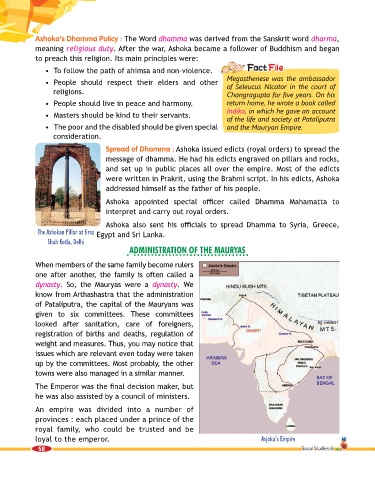
              The Ashokan Pillar at firoz  Egypt and Sri Lanka.
                 Shah Kotla, Delhi
                                              admInIstratIon of tHe mauryas

             When members of the same family become rulers
             one after another, the family is often called a
             dynasty. So, the Mauryas were a  dynasty. We
             know from Arthashastra that the administration
             of Pataliputra, the capital of the Mauryans was

             given to six committees.  These committees
             looked after sanitation, care of foreigners,
             registration of births and deaths, regulation of
             weight and measures. Thus, you may notice that
             issues which are relevant even today were taken
             up by the committees. Most probably, the other
             towns were also managed in a similar manner.

             The Emperor was the final decision maker, but
             he was also assisted by a council of ministers.

             An empire was divided into a number of
             provinces : each placed under a prince of the

             royal family, who could be trusted and be
             loyal to the emperor.                                                         Asjoka’s Empire
              58                                                                                         Social Studies-6

