


Page 53 - sst_class_06
P. 53
Janapadas and Mahajanapadas


                  chapter  11            jaNapadaS aNd


                                         maHajaNapadaS


             In later Vedic period, the large-scale use of iron tools helped to clean the dense forests of
             North of the Ganga. Some of the states grew up into powerful empires. They had a separate
             government for administration and were independent from any external control. Farming in
             these fertile areas yields rich crops. So, the Aryans rapidly expanded their territories eastwards.

             Janapadas : From the  6th  Century  BC  onwards,  the  widespread  use  of iron in  Eastern
             Uttar Pradesh and western Bihar created conditions for the formation of large territorial
             states. The farmer could produce more food grains and the extra produce was collected
             by the princess to meet their military and administrative needs. This gave rise to proper
             settlements called Janapadas. The term ‘Janapada’ literally means the foothold of a tribe.
             The fact that Janapada is derived from Jana suggests the taking of land by a Jana tribe for
             a settled way of life.

             The main sources of information of this period are the Vedic and Buddhist texts. The Vedic
             texts like Upanishads give information about the Janapadas and Mahajanapadas.

             Various ancient settlements were discovered by the archaeologists such as Purana Qila in Delhi
             and Hastinapur near Meerut and Atranjikhera in Uttar Pradesh. The animal and plant remains
             show that the people reared mainly cattle and cultivated crops such as barley, rice, wheat,
             sugarcane, pulses and peas. The remains of pottery found at the sites are of two main types—a
             type of grey pottery with painted designs, known as Painted Grey Ware (PGW) and red pottery.
                                                        maHaJanapadas

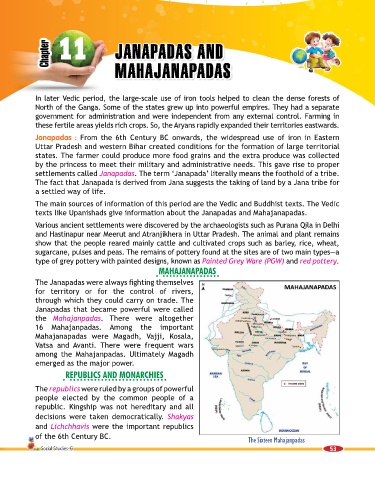
             The Janapadas were always fighting themselves
             for  territory or for  the  control of rivers,
             through which they could carry on trade. The
             Janapadas that became powerful were called
             the  Mahajanpadas.  There  were  altogether
             16  Mahajanpadas.  Among the  important
             Mahajanapadas  were  Magadh,  Vajji, Kosala,
             Vatsa  and  Avanti.  There were  frequent  wars
             among the  Mahajanpadas.  Ultimately  Magadh
             emerged as the major power.

                        repuBlIcs and monarcHIes

             The republics were ruled by a groups of powerful
             people elected  by the  common people of  a
             republic.  Kingship  was  not  hereditary  and  all
             decisions  were taken  democratically.  Shakyas
             and Lichchhavis were the important republics
             of the 6th Century BC.                                                    The Sixteen Mahajanpadas

               Social Studies-6                                                                                    53

