


Page 54 - sst_class_06
P. 54
In the monarchial Mahajanpadas, the head of the state was a Monarch or a king. He was
             a hereditary ruler with the throne passing from father to son. For example, Magadh and
             Avanti were two monarchies.
                                           maIn features of tHe maHaJanpadas

             Most Mahajanpadas had a capital city and were fortified. Huge walls of wood, brick or
             stone were built around them. It not only provided security but also clearly demarked their
             area and the people living inside the fortified area could be controlled more easily by the
             king. In these Mahajanpadas, the kings maintained large well equipped armies. Soldiers
             were paid regular salaries and were maintained by their king throughout the year.

                               There were 16 Mahajanpadas in the Early 6th Century BC

               1.  Anga             –  Bhagalpur in Bihar             2.  Magadha  –  Patna in Bihar
               3.  Kashi            –  Varanasi in Uttar Pradesh  4.  Kosala          –  Awadh-Lucknow region
                                                                                        of Uttar Pradesh

               5.  Vajji or Vrijji  –  North Bihar                    6.  Malla       –  Gorakhpur in Uttar Pradesh
               7.  Chedi            –  East of Bundelkhand            8.  Vatsa       –  Allahabad in Uttar Pradesh

               9.  Kuru             –  Delhi                         10.  Panchala  –  Bareilly
              11.  Matsya           –  Jaipur in Rajasthan           12.  Surasena  –  Mathura in Uttar Pradesh
              13.  Asmaka           –  Godavari Valley               14.  Avanti      –  Ujjain in Madhya Pradesh

              15.  Gandhara         –  Rawalpindi and Kabul          16.  Kamboja  –  Afghanistan
                                       (Now in Pakistan)

             Economic and Social Life : Agriculture prospered in most of the Mahajanpadas as they were
             located in fertile areas. The republics, however, were mostly in less fertile or hilly regions.
             Many canals and wells were dug to improve irrigation. The farmers learnt
             to use manure. The improved farming techniques improved the quality
             and quantity of crops produced. Trade and commerce flourished in this
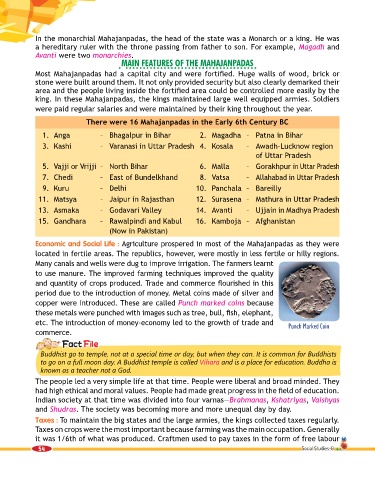
             period due to the introduction of money. Metal coins made of silver and
             copper were introduced. These are called Punch marked coins because
             these metals were punched with images such as tree, bull, fish, elephant,
             etc. The introduction of money-economy led to the growth of trade and                   Punch Marked Coin

             commerce.


               Buddhist go to temple, not at a special time or day, but when they can. It is common for Buddhists
               to go on a full moon day. A Buddhist temple is called Vihara and is a place for education. Buddha is
               known as a teacher not a God.
             The people led a very simple life at that time. People were liberal and broad minded. They
             had high ethical and moral values. People had made great progress in the field of education.
             Indian society at that time was divided into four varnas—Brahmanas, Kshatriyas, Vaishyas
             and Shudras. The society was becoming more and more unequal day by day.

             Taxes : To maintain the big states and the large armies, the kings collected taxes regularly.
             Taxes on crops were the most important because farming was the main occupation. Generally
             it was 1/6th of what was produced. Craftmen used to pay taxes in the form of free labour
              54                                                                                         Social Studies-6

