


Page 29 - sst_class_06
P. 29
i. The hiMadri (The greaTer hiMalaya)

             This is the  northern  most and  the  highest  range  of Himalaya. These  are  highest  of all
             mountains. They run from Indus to Brahmaputra. The highest peak is Mt. Everest (8,848 m).

             Others are Kanchenjunga, Dhaulagiri and Nanda Devi, etc.
             ii. The hiMaChal (The leSSer hiMalaya)

             The Himachal is to the south of the Himadri. The mountains here are lower than those

             of the Himadri. This range has many beautiful valleys. The mountains slopes are covered
             with thick forests of pine, deodar and fir trees. Many beautiful hill stations like Nainital,
             Mussoorie, Shimla, Srinagar, Kullu Manali, Dharamshala, Darjiling, etc. are located in this
             range.


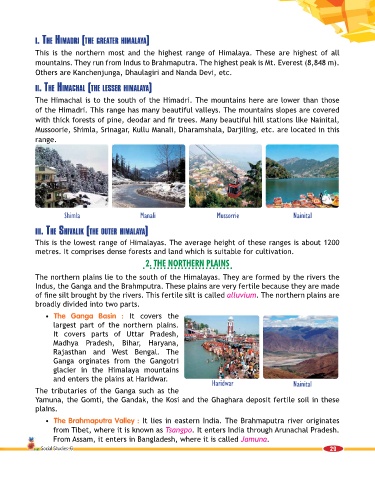
                       Shimla                    Manali                     Mussorrie                 Nainital

             iii. The Shivalik (The ouTer hiMalaya)

             This is the lowest range of Himalayas. The average height of these ranges is about 1200
             metres. It comprises dense forests and land which is suitable for cultivation.

                                                   2. the northern PlainS

             The northern plains lie to the south of the Himalayas. They are formed by the rivers the
             Indus, the Ganga and the Brahmputra. These plains are very fertile because they are made
             of fine silt brought by the rivers. This fertile silt is called alluvium. The northern plains are
             broadly divided into two parts.

                 •   The  Ganga Basin  : It  covers the
                   largest part of  the  northern  plains.
                   It  covers parts of  Uttar  Pradesh,
                   Madhya  Pradesh,  Bihar, Haryana,
                   Rajasthan  and  West Bengal.  The
                   Ganga  orginates  from  the  Gangotri
                   glacier in the  Himalaya  mountains
                   and enters the plains at Haridwar.
                                                                          Haridwar                    Nainital
             The tributaries of the Ganga such as the
             Yamuna, the Gomti, the Gandak, the Kosi and the Ghaghara deposit fertile soil in these
             plains.

                 •   The Brahmaputra Valley : It lies in eastern India. The Brahmaputra river originates
                   from Tibet, where it is known as Tsangpo. It enters India through Arunachal Pradesh.
                   From Assam, it enters in Bangladesh, where it is called Jamuna.
               Social Studies-6                                                                                    29

