


Page 34 - sst_class_06
P. 34
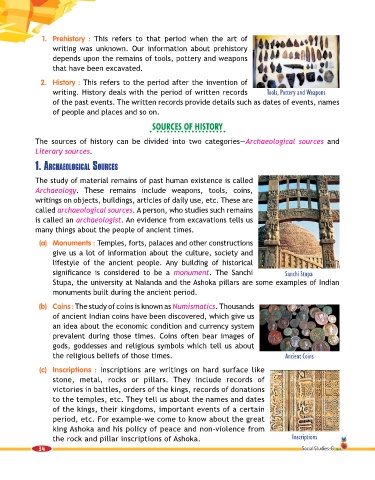
1.   Prehistory  :  This refers  to that  period when  the  art of
                   writing  was unknown. Our information  about  prehistory

                   depends upon the remains of tools, pottery and weapons
                   that have been excavated.

               2.   History : This refers to the period after the invention of
                   writing. History deals with the period of written records                 Tools, Pottery and Weapons
                   of the past events. The written records provide details such as dates of events, names
                   of people and places and so on.

                                                      sources of HIstory

             The sources of  history can  be  divided  into  two categories—Archaeological sources and

             Literary sources.

             1. ArchAeologicAl SourceS

             The study of material remains of past human existence is called
             Archaeology.  These remains include weapons, tools, coins,
             writings on objects, buildings, articles of daily use, etc. These are
             called archaeological sources. A person, who studies such remains
             is called an archaeologist. An evidence from excavations tells us
             many things about the people of ancient times.

               (a)  Monuments :  Temples, forts, palaces and other constructions

                   give us a lot of information about the culture, society and
                   lifestyle  of  the  ancient  people.  Any  building  of  historical
                   significance  is  considered  to  be  a  monument.  The  Sanchi                  Sanchi Stupa
                   Stupa, the university at Nalanda and the Ashoka pillars are some examples of Indian
                   monuments built during the ancient period.

               (b)  Coins : The study of coins is known as Numismatics. Thousands
                   of ancient Indian coins have been discovered, which give us
                   an idea about the economic condition and currency system
                   prevalent  during  those  times.  Coins often  bear  images  of

                   gods, goddesses and religious symbols which tell us about
                   the religious beliefs of those times.                                            Ancient Coins

               (c)  Inscriptions :  Inscriptions  are  writings  on hard  surface  like
                   stone, metal, rocks or  pillars.  They  include  records of
                   victories in battles, orders of the kings, records of donations
                   to the temples, etc. They tell us about the names and dates
                   of the kings, their kingdoms, important events of a certain
                   period, etc. For example-we come to know about the great

                   king Ashoka and his policy of peace and non-violence from
                   the rock and pillar inscriptions of Ashoka.                                        Inscriptions
              34                                                                                         Social Studies-6

