


Page 24 - sst_class_06
P. 24
2. The aTlanTiC oCean :

             The Atlantic Ocean is the second largest ocean. It is ‘S’ shaped. It is surrounded by North
             America and South America in the west and Europe and Africa in the east.

             3. The indian oCean :

             It is the only ocean that has been named after our
             country India. The shape of this ocean is almost            The Atlantic ocean was named after the
             triangular. In the north, it is bound by Asia, in the       Atlas mountains in north-western Africa.
             west by Africa and in the east by Australia.

             4. The arCTiC oCean :

             Most of the Arctic Ocean is permanently covered with
             a vast floating raft of sea ice. Here temperatures are         Some  scientists place

             very low, averaging -30°C in winter and sometimes              frozen water-glaciers,
             dropping to  -70°C. It is located within the Arctic            ice caps and icebergs
             Circle and surrounds the North Pole. It is connected           in its own sphere called
             with the Pacific Ocean by  narrow stretch of shallow           the “cryosphere.”
             water  known  as  Berring Strait. It  is bounded  by
             northern coasts of North America and Eurasia.

                                                         3. atmoSPhere


                                                      The  Earth  is surrounded  by  a  layer  of gases  called
                                                      the atmosphere. The atmosphere has many gases like
                                                      nitrogen, oxygen, carbon dioxide and other gases. Every
                                                      gas has its specific role in the nature and is essential
                                                      for  the  existence  of life.  For example—nitrogen  gas

                                                      is used by plants as a fertilizer, carbon dioxide gas is
                                                      used by plants for making food, oxygen is necessary for
                                                      breathing for all living things, etc.
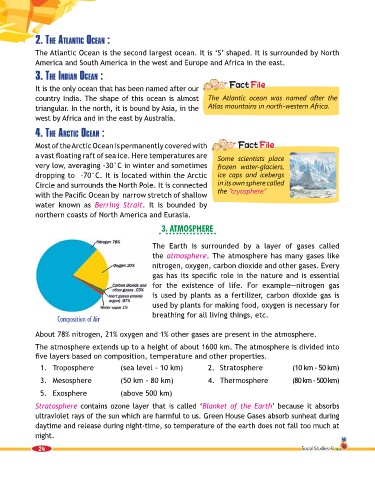
                     Composition of Air

             About 78% nitrogen, 21% oxygen and 1% other gases are present in the atmosphere.

             The atmosphere extends up to a height of about 1600 km. The atmosphere is divided into
             five layers based on composition, temperature and other properties.
               1.  Troposphere             (sea level - 10 km)           2.  Stratosphere             (10 km - 50 km)

               3.  Mesosphere              (50 km - 80 km)               4.  Thermosphere             (80 km - 500 km)

               5.  Exosphere               (above 500 km)
             Stratosphere contains ozone layer that is called ‘Blanket of the Earth’ because it absorbs

             ultraviolet rays of the sun which are harmful to us. Green House Gases absorb sunheat during
             daytime and release during night-time, so temperature of the earth does not fall too much at
             night.

              24                                                                                         Social Studies-6

