


Page 37 - sst_class_07
P. 37
2. sEdimENtary rocks
             Rocks are constantly broken down into  smaller
             fragments and carried away by wind, water or ice

             and  deposited  either  on the  sea  bed  or on land.
             These smaller particles are called sediments. These
             sediments are compressed, hardened and cemented
             together to form layers of rocks called sedimentary
             rocks or  stratified  rocks. Sandstone  and  limestone
             are two important examples of sedimentary rocks.
             Sedimentary rocks are made up of particles of various

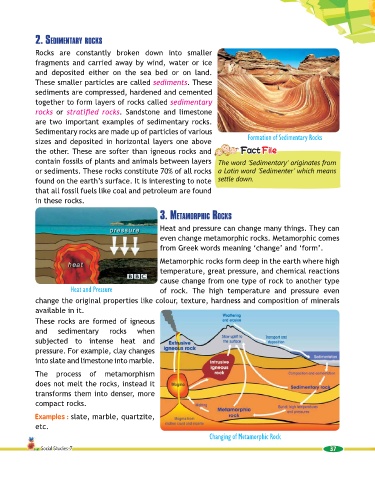
             sizes and deposited in horizontal layers one above                        Formation of Sedimentary Rocks
             the other. These are softer than igneous rocks and
             contain fossils of plants and animals between layers           The word ‘Sedimentary’ originates from
             or sediments. These rocks constitute 70% of all rocks  a Latin word ‘Sedimenter’ which means
             found on the earth’s surface. It is interesting to note        settle down.
             that all fossil fuels like coal and petroleum are found
             in these rocks.


                                                        3. mEtamorphic rocks
                                                        Heat and pressure can change many things. They can
                                                        even change metamorphic rocks. Metamorphic comes
                                                        from Greek words meaning ‘change’ and ‘form’.

                                                        Metamorphic rocks form deep in the earth where high

                                                        temperature, great pressure, and chemical reactions
                                                        cause change from one type of rock to another type
                         Heat and Pressure              of  rock.  The  high  temperature  and  pressure  even

             change the original properties like colour, texture, hardness and composition of minerals
             available in it.
             These rocks are formed of igneous
             and     sedimentary       rocks    when
             subjected to intense heat and

             pressure. For example, clay changes
             into slate and limestone into marble.

             The  process of metamorphism
             does not melt the rocks, instead it
             transforms them into denser, more
             compact rocks.

             Examples : slate, marble, quartzite,
             etc.
                                                                         Changing of Metamorphic Rock

               Social Studies-7                                                                                    37

