


Page 35 - sst_class_07
P. 35
Chapter  6             inSidE tHE EArtH


             Earth is also known as the Terra. It is the third planet outward from the sun. It is the largest of
             the solar system’s terrestrial planes, and the only planetary body that modern science confirms
             as harbouring life. This planet formed around 4.57 billion years ago and shortly thereafter
             acquired its single natural satellite, the Moon. Its dominant species is the human.


                                  intErior of thE Earth

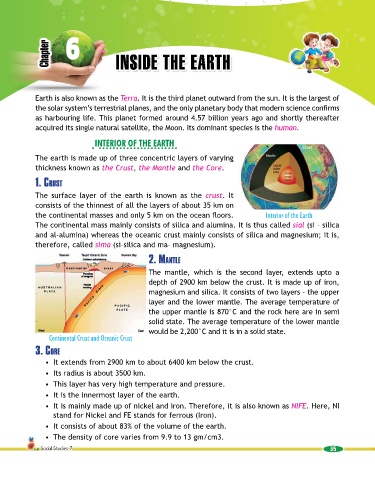
             The earth is made up of three concentric layers of varying
             thickness known as the Crust, the Mantle and the Core.

             1. crust

             The surface layer of  the  earth  is known  as the  crust. It
             consists of the thinnest of all the layers of about 35 km on
             the continental masses and only 5 km on the ocean floors.                       Interior of the Earth

             The continental mass mainly consists of silica and alumina. It is thus called sial (si – silica
             and al–alumina) whereas the oceanic crust mainly consists of silica and magnesium; it is,
             therefore, called sima (si–silica and ma– magnesium).

                                                    2. maNtlE

                                                    The mantle, which is the second layer, extends upto a
                                                    depth of 2900 km below the crust. It is made up of iron,
                                                    magnesium and silica. It consists of two layers – the upper
                                                    layer and the lower mantle. The average temperature of
                                                    the upper mantle is 870°C and the rock here are in semi
                                                    solid state. The average temperature of the lower mantle
                                                    would be 2,200°C and it is in a solid state.
                  Continental Crust and Oceanic Crust

             3. corE
                 •  It extends from 2900 km to about 6400 km below the crust.

                 •  Its radius is about 3500 km.
                 •  This layer has very high temperature and pressure.
                 •  It is the innermost layer of the earth.
                 •  It is mainly made up of nickel and iron. Therefore, it is also known as NIFE. Here, NI
                   stand for Nickel and FE stands for ferrous (Iron).

                 •  It consists of about 83% of the volume of the earth.
                 •  The density of core varies from 9.9 to 13 gm/cm3.

               Social Studies-7                                                                                    35

