


Page 41 - sst_class_07
P. 41
Chapter  7             lifE in tHE dESErt


             Deserts are areas of the earth’s surface which receive less than 25 cm or 10 inches of
             rainfall every year. They contain little or no vegetation. The main characteristics of deserts
             are : rare clouds, little rain, very hot days, very cold nights.

             Deserts are characterised by extremely high or low temperature, low rainfall and scanty
             vegetation. Depending on the temperature, there can be hot deserts or cold deserts.

                                                      hot dEsErt–sahara


             locatioN

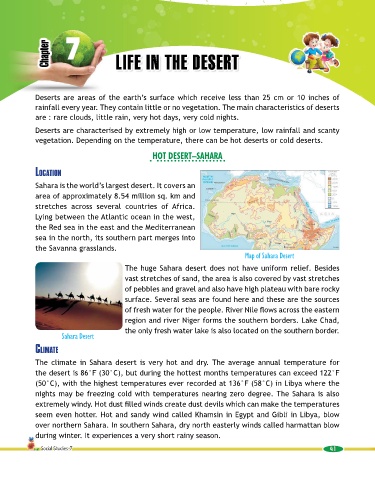
             Sahara is the world’s largest desert. It covers an
             area of approximately 8.54 million sq. km and

             stretches  across  several  countries  of  Africa.
             Lying between the Atlantic ocean in the west,
             the Red sea in the east and the Mediterranean
             sea in the north, its southern part merges into
             the Savanna grasslands.
                                                                                      Map of Sahara Desert

                                            The huge Sahara desert does not have uniform relief. Besides
                                            vast stretches of sand, the area is also covered by vast stretches
                                            of pebbles and gravel and also have high plateau with bare rocky

                                            surface. Several seas are found here and these are the sources
                                            of fresh water for the people. River Nile flows across the eastern
                                            region and river Niger forms the southern borders. Lake Chad,
                                            the only fresh water lake is also located on the southern border.
                      Sahara Desert

             climatE

             The climate in Sahara desert is very hot and dry. The average annual temperature for
             the desert is 86°F (30°C), but during the hottest months temperatures can exceed 122°F

             (50°C), with the highest temperatures ever recorded at 136°F (58°C) in Libya where the
             nights may be freezing cold with temperatures nearing zero degree. The Sahara is also
             extremely windy. Hot dust filled winds create dust devils which can make the temperatures
             seem even hotter. Hot and sandy wind called Khamsin in Egypt and Gibli in Libya, blow

             over northern Sahara. In southern Sahara, dry north easterly winds called harmattan blow
             during winter. It experiences a very short rainy season.

               Social Studies-7                                                                                    41

