


Page 36 - sst_class_07
P. 36
•   Guttenberg Discontinuity :   It separates mantle and core. This is named after the world famous
                   geologist Guttenberg.
               •   Mohorovicic Discontinuity : It is a layer found in semi molten state between the crust and
                   mantle. It is named after the famous geologist Mohorovicic.

                                              matErials of thE Earth’s Crust

             All solid materials of the earth’s crust, whether hard

             or  soft, that  make  up the  earth’s crust are called
             Rock. They are of different size, texture and colours.
             Rocks are generally solid mass but also include loose

             materials such as sand, soil, silt.

             Minerals  are  substances  which  occur in  rocks. The
             main characteristics are as follows:
                 •  They  have  a  definite  chemical  composition.
                   Each  mineral contains two or  more simple                               Rocks and Minerals
                   substances called elements.
                 •  They are non-living solid substances.

                 •  They provide us metals and chemicals.
                 •  A rock in which a particular mineral is found in large percentage is called an ORE.

             On the basis of formation, the rocks are classified into three types : igneous, sedimentary
             and metamorphic.

             1. igNEous rocks
                                                        The oldest type of all rocks is the igneous rock. The word
                                                        “igneous” has been derived from a Greek word which

                                                        means “fire”. These rocks are formed by the cooling and
                                                        solidification of molten rocks. When a volcano erupts,
                                                        molten rock called magma comes out on the earth’s
                                                        surface  and  when  the  magma  cools  and  solidifies,  it
                                                        leads to the formation of igneous rocks. Examples are :
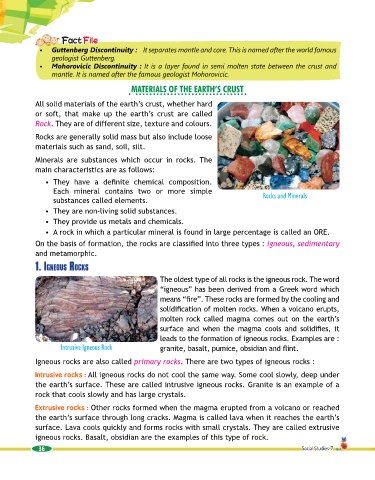
                      Intrusive lgneous Rock            granite, basalt, pumice, obsidian and flint.

             Igneous rocks are also called primary rocks. There are two types of igneous rocks :

             Intrusive rocks : All igneous rocks do not cool the same way. Some cool slowly, deep under
             the earth’s surface. These are called intrusive igneous rocks. Granite is an example of a
             rock that cools slowly and has large crystals.

             Extrusive rocks : Other rocks formed when the magma erupted from a volcano or reached
             the earth’s surface through long cracks. Magma is called lava when it reaches the earth’s
             surface. Lava cools quickly and forms rocks with small crystals. They are called extrusive
             igneous rocks. Basalt, obsidian are the examples of this type of rock.

                                                                                                         Social Studies
              36                                                                                         Social Studies-7-7
              36

